Showing posts with label snake. Show all posts

Tuesday, February 4, 2020

How to differentiate between Russell's Viper and Rock Python

Day by day Russell”s Viper(Daboia russelli) is becoming the most medically important snake for Eastern India. So it is very essential to identify this snake properly and do not confuse it with other similar snake like Indian Rock Python(Python molurus), which is a non-venomous snake.

To understand why it is becoming so important, we need to understand how we fight snakebite in our country. The only treatment is Polyvalent Antivenom Serum (ASV), which is administered to the victim in case of venomous snakebite. This ASV is made from the venom of Cobra(Naja naja), Russell’s viper, Common Krait(Bungarus caeruleus) and Saw scaled viper(Echis carinatus). Most of the ASV production centers are situated in South India and all the snakes they use for ASV venom collection are collected from South India. Now-a-days this ASV is proving to be less effective in combating Russell’s Viper bite in Eastern India. The geographical variation has changed the chemical composition of Russell’s Viper’s venom from South India to North India. The studies of snakebite and its treatment clearly indicates this. In Eastern India it is becoming harder and harder to treat a Russell’s Viper bite victim. So doctors and experts are requesting to setup a venom collection center in Eastern India so we can eliminate geographical variation but till now Govt has not reacted positively.

Anyway, the best way is not to get bitten in the first place. For that you need to identify it properly. People often confuse Russell’s viper with Rock python as both have stocky muscular body and generally brown coloration with dark spots. But following these simple points you can be sure which one is which. But venomous or non-venomous, you should not try to handle any of these snakes. It is always better to give them their space and let them escape. Or call the local forest dept.


Russell’s viper generally grows to about 1m in length, whereas the Rock python in average grows to about 3m in length. So if you guess the length to be around 2m or more, you can be sure it to be a Rock python. But do not totally depend on this as snakes when coiled can look much longer or shorter than they actually are.

From a distance we can see the body pattern. Russell’s Viper has well defined round or oval shaped patterns along its back which are a bit pointed at two ends. They also have half or full oval blotches along their side. Now depending on the location of the specimen, these blotches can be dark edged with light center (North India) or solid dark (South India). The patterns on Rock python are asymmetrical and in general quadrate in shape. They are mostly solid dark sometimes with light center.

Inspection of the head and neck revels many more differences. In Russell’s viper the head is triangular in shape. The head of Rock python is elongated. Typical of all the vipers, Russell’s viper’s neck is also very distinct from its body where as Rock python’s neck is not so distinct. Russell’s viper’s head is covered with many small keeled scales. Rock python’s head is covered with few big smooth scales. Python also has 3 slits on its upper lips frontal side on both side which are its temperature sensory organ. This feature is not so easily visible. Russell’s viper does not have this. Both the snake have vertical pupil.
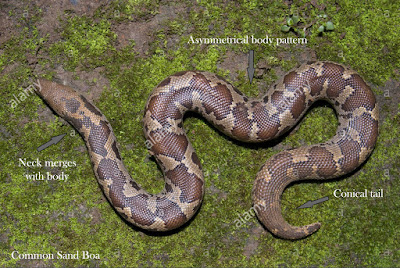
One other small snake is often mistaken for being Russell’s viper which is the Common Sand Boa(Gongylophis conicus). This snake is also called Russell’s boa. Sand boa has many physical similarities with Russell’s viper except its name. They both have a thick stout body. They both have a overall brown coloration with dark blotches. Both Russell’s viper and Russell’s boa have their head covered with many small keeled scales. Both these snakes have vertical pupil. But they have their differences too. Sand boa’s body tapers to both end very rapidly so its tail is almost conical in shape. Sand boa’s neck is so thick that it merges with body. Also the blotches on Sand Boa’s body is very asymmetrical and does not conform to any shape. Sand boa generally grows to about 0.5m-0.6m in length and rarely grows to about 1m.

One distinct feature which separate Russell’s viper from Sand Boa, Rock python or any other snake is its loud Hiss. It is so loud that almost compares to the sound of a ‘Pressure Cooker’. Once heard you will never forget it.


To learn more about them, follow these links.

Indian Rock Python

Common Sand Boa

Russell's Viper


To learn about the difference between Common Krait and Common Wolf Snake.

To learn about the difference between Indian Rat Snake and Cobra.


**images have been mostly collected from internet for the sole purpose of awareness and education. copyright of every image stays with their rightful owner. **

Tuesday, January 21, 2020

How to differentiate between Rat snake vs Indian Cobra

A few days back while on duty I was chatting with a senior colleague and found out about his interest in snakes. So I showed him my blog. As he was browsing through my posts, he told me a story of how he once escaped a cobra bite just by chance. Then he asked me about how a common man can differentiate between a Cobra (Naja naja, Naja kaouthia) and a Rat Snake (Ptyas mucosa).

That question hit my head too. As I searched the internet for some ready article to differentiate between them, I could not find any. So I tried to compile points I found in various places into a single article so that anyone can refer to it and stay safe.

A word of CAUTION. Even if you know the snake infront of you is a non-venomous rat snake, not a venomous cobra, DO NOT TRY TO HANDLE IT! That is harmful for both the snake and yourself. Give it some space to escape and it will escape eventually.


If I explain from the easiest sign to hardest, the first and most intimidating sign would be the hood. Cobras (when I mention cobra, I am referring to both Monocled Cobra and Spectacled Cobra) raise hood when threatened. Monocled cobra has a ‘eye’ like design on the back of its hood whereas Spectacled Cobra has a ‘U’ shaped marking or it may have no marking on the back of its hood. To display its hood, a cobra raises its forebody from the ground and flares its neck. Now the Rat Snake also mimics this behavior just to pretend to be a cobra. The rat snake also lifts its forebody and tries to flare it neck. But its neck does not create a hood.


But what if a cobra does not raise a hood? May be it didn’t see you or may be it didn’t see you as a threat, then how can you tell. In that case we have to see the head carefully. On the Rat Snake, along its lips below the eye, there are prominent black vertical stripes. The cobra lacks this vertical black stripes.


Do not try to differentiate them by the color of their body. Both the Rat Snake and Cobras vary highly in body coloration. Their color can be from very light to very dark. Monocled Cobra juveniles have mostly dark colors with light banding across the body. The color fades to olive as they mature, the banding fades too. You can usually find black makings on the rear portion of an adult Rat Snake. Also, rat snake has black markings on it belly side.


But if they vary so much, how the experts tell them apart? They count the scales on their body, on their head and on their tail. That is the only sure way to tell two species of snake apart. But that process is not for the common man as that requires you to handle the snake. But if you are still interested to know about the scalation, follow these links to find out more.


To learn about the difference between Common Krait and Wolf Snake.

To learn about the difference between Russell's Viper and Sand Boa.


**images have been mostly collected from internet for the sole purpose of awareness and education. copyright of every image stays with their rightful owner. **

Thursday, January 16, 2014

New Year Gift ( Yellow Speckled Wolf Snake)

This day I got a call from a friend asking me if I would collect a snake they have captured or would they kill it. And I certainly told him to keep the snake for me. Then I asked him about the description of the snake and came to know that it is a green snake with spots on it. I was not sure which snake it was from the description but as it is not similar to any venomous snakes found here locally, I told him, “it is probably a non-venomous snake but still don’t touch it.”

This conversation happened in the morning and I was told to pick up the snake in the evening. The whole day I was thinking about the snake but could not decide what it could be and in the evening when I received the snake, reality exceeded all my expectations! It was a small snake, approximately 12”-14” long with brownish green back and white belly. Moreover it had two yellow spots on each scale. And I shouted in joy, “it’s a yellow-speckled wolf snake!!!!” whenever I saw its photo in books and various online groups, I wished to see one in real life but its distribution is so limited that I never thought I would see one ever, that too in my hometown. It was 2nd January and all I could think was that this was the best new year gift ever.

Yellow Speckled Wolf Snake ( Lycodon jara ) is a non-venomous snake found from West Bengal, Arunachal Pradesh and Ganjam district of Orissa in India and also from Nepal and Bangladesh. The maximum length recorded is 22”. It’s a smooth scaled, slender bodied snake. The head is slightly broader than the neck like all other wolf snakes. The upper side varies from glossy brown to purplish black. Belly side is white in color. Almost all the scales on its back have two yellow spots on them and thus the name. Sometime the spots are white in color. Very little is known about this snake. Only that it is a nocturnal snake and it eats geckos.
From my personal observation I found that this snake prefers corners and crevices than open place. Though it is a nocturnal snake, given a choice to stay between a dark open place and a bright corner, it feels more secure in the corner. It also hides its head slightly under its body coil like a few other wolf snakes. “And unlike the Common Wolf Snake, not tempermental and usually does not bite when handled.” Though the previous line was written for a few other wolf snakes like Barred Wolf Snake in the book ‘Snakes of India, The Field Guide’, I found it perfectly suitable for this one too.

When I released it in my own front yard, it was very quick to vanish from my eye and I am sure not to see it again ever though it is just in front of my house. Snakes have evolved to stay hidden so good that we often don’t realize how many snakes are there around us. That is infact in the benefit of both of us. Otherwise we would have killed all the snakes if we had the chance, or atleast that is the mentality of many of us. But it is good to know that people are changing. Thank you Utpal Das for this wonderful new year gift.

Sunday, June 17, 2012

10 points to avoid snakebite


As the rainy season is approaching, the interaction with snakes is about to increase for everyone. But as it is not desirable for most of us, a simple few steps could help us avoid them altogether. It will also save many lives of both men and snakes.

Conflicts with snakes mainly happen at two places, inside the house and outside the house. Let us first understand why snakes enter houses. Snakes enter mainly for two reasons, to hunt and to take shelter. Snakes often enter houses to hunt for rats, mice and toads that take refuse in our houses. Another reason is taking shelter. Snakes, like other reptiles go into hibernation, i.e. a long period of inactivity, for 2-3 months in the winter season. So they look for places where they can safely hibernate and keep out from the winter chill. The same thing happens in summer too. To beat the heat they try to find a cool shaded place to aestivate. In nature snakes seek out places like underground tunnels, under fallen trees or brunches, under big stones etc. human homes offer perfect alternatives of these in the form of cluttered corners, unused rooms, under the stairs, behind the almirah etc.


And out side the house conflicts happen when people accidentally step on them or go near them. Snakes generally hunt in the morning and evening when the temperature of the atmosphere is moderate. In the noon, when the temperature is high snakes take rest under dry leaves, under fallen logs, inside holes in tree trunks, under the exposed roots etc.


So if we sum up the points, it will go like these.

  1. Free our homes from rats and toads by using poison, traps, hand picking etc.
  2. Clean the house and neighborhood and see that no garbage is staying for too long like pile of bricks, heap of firewood etc.
  3. Snakes don’t like the smell of carbolic acid, bleaching powder etc. so using these around houses can reduce incoming of snakes.
  4. People generally get bitten at night because they don’t see the snake in dark and step on it accidentally. So using a flashlight in snake infested areas in the night will reduce snake bite.
  5. Generally people get bitten on the foot. So using a ankle high shoe can reduce snake bite also.
  6. As snakes take rest under exposed tree roots, under heap of dry leaves etc, we should be careful when passing them or stepping on them.
  7. In the harvesting season snakes gather around the fields to hunt rats because rats gather in great numbers to collect food grain. So be careful when roaming in the field especially in the harvesting season.
  8. Snakes generally bite only when it is cornered. So if you accidentally come near a snake, give it room to escape and it will escape at the first chance.
  9. Most ground dwelling snakes don’t have very good eyesight; they feel our presence through vibration on ground. So in front of a snake, if we stay still, it wont be able to recognise our presence and eventually it will go.
  10. Snakes like the warmth of our body and blankets and hide in our beds. As a result, many people get bitten while they are sleeping and if the bite is from a Krait, you wont even feel the bite. So always check the carefully before going to bed and use a mosquito net.

You see these 10 points are no rocket science. They are just general awareness that we need to maintain. And you will be surprised to see the result of it. It will surely lower the chance of getting bitten by a snake. So keep safe and enjoy monsoon.

Tuesday, April 24, 2012

Tragic Hero (Ornate Flying Snake)

People fear snakes. And writers have manipulated this reaction from ancient times. As tragedy is more interesting than comedy, fear is also more interesting than love. So writers have stitched false information about snakes in their stories to create a fearful atmosphere. One of the classic examples is the ‘Manasamangal’.

It is a classic Bengali story of a businessman and his family who was involved in a conflict with the goddess of snakes, ‘Manasa’. This story tells that Manasa sent a very deadly, very venomous snake, ‘Kalnagini’ to kill the youngest son of that businessman. Now as most of the people don’t read science journals but they have read or heard this story at least once in West Bengal, they regard Kalnagini as a very dangerous snake capable of killing human being with its venom. And I can’t blame them for that. Nobody has ever told them otherwise.

Now what the truth really is?? What is this infamous Kalnagini? Kalnagini or Ornate Flying Snake (Chrysopelea ornata) is a very beautiful and handsome snake. As like every other tree snake, it is also slim and long, average length 1.2m . Overall coloration is greenish yellow or pale green above with black cross bands. Scales also have black borders. Every alternate cross band has reddish or orange patches in vertebral area. The head is black with white and red patches. This is a diurnal and arboreal snake, meaning it is active in daytime and it prefers trees and bushes than grounds. It generally feeds on frogs, lizards, small mammals, birds and even bats. Ornate Flying Snake is not very choosy in its diet and eats whatever it can capture.


And about its deadliness, Ornate Flying Snake has elongated, grooved teeth for delivering the venom. It falls under the category of ‘Rear Fanged Snake’ because its elongated teeth are at the rear of its jaws unlike other venomous snakes which have these at the front. Most importantly, it has very mild venom to subdue its prey but which is totally ineffective against the human. IT CAN NOT KILL A HUMAN. Only side effects like allergic effects, numbness of the bitten area etc can happen.

Being non-venomous or correctly say mildly-venomous does not make it any less interesting. It has a very unique characteristic which only a few other snake poses. It can’t fly but it can glide in air 50m-100m depending upon the height it jumps from. It flattens its body, hollows out ventrally and jumps at an angle with respect to ground. Flattened body helps it to glide through the air and by swinging its tail, it can control the direction of glide. Isn’t that a great achievement for an animal which doesn’t even have hands or legs?

Now come back to the story of Manasamangal again. I would not say the writer didn’t know it is a mildly-venomous snake. Rather he used this snake for this particular feature. No venomous snake would serve his purpose. In the story, after the youngest son got bitten by Kalnagini, his wife took him to heaven and pleased gods by singing and dancing to return his husband’s life. What if she didn’t do it and stayed home? It would have brought the same result. Her husband would not die in either case. You see why I said the writer choose this snake purposefully? Because if any venomous snake had bitten him, even the gods would not be able to save him without the antivenin. And this also the reason why snake charmers can successfully heal people from snake bite sometimes.

Sunday, February 12, 2012

Super cobra in the making...

A few days back I went to a friend’s house but she was not home. So I was chatting with her mother. As the topic of snakes came along, she told me a very fascinating story.
2-3 years back, one morning one snake was spotted in their locality. There was a medium sized water tank with water and the snake was in it. When they identified it as cobra, they called a snake charmer. Even he could not catch the snake because of the water, so people decided to kill it. After beating the snake severely with sticks and rods, they put the snake on ground. And suddenly the cobra regurgitated another snake. And guess what, that was a cobra too. The first cobra was approx 4.5ft long and second one from 3-3.5ft.


Now this was interesting for me because I have not heard of cobras feeding on cobras or any other snake previously. So I started to look for material on this subject. King cobras and Kraits are known to feed on snakes but could not find anything related to cobras. Then suddenly I stumbled upon a image in an online group, Indian Snakes. It not only proved the previous story, the comments gave a whole array of information.


The photo was originally posted by Mr Rajeevan Shri in another group DiversityIndia. And this was the supporting text “While travelling through country side around Quilon found this. People beaten the cobra very badly it was dying when the pic was taken' cobra was about 5feet long &viper about 3.5feet long. Taken 1998 Dec.” Now when I went through the comments I saw that one person says that he has seen a cobra feeding on a daboia before and this is the second time he is seeing this. Another person says that he saw a cobra vomit a daboia before while his friend was rescuing the cobra. And one person added even more interesting fact. He has seen cobra feeding on rat snake and even a rat snake feeding on trinket snake.

These could be some very unusual individual incidents or these could be showing a trend. The snakes, especially the cobra may have started to change their feeding behaviour. An easy conclusion could be drawn that the scarcity of prey species have forced them to target different species but their main prey, the rats have flourished with the human very well and are not scarce. May be inter species competition is forcing the cobras to be superior than the daboia and feed on that species. Well, these are just my imagination and the real reason could only be found by scientifically investigating the whole matter.

Sunday, November 27, 2011

Deadly affair (common indian krait)

On this evening, I was browsing internet in my room, suddenly I heard some people talking about some snake. It seemed like somebody have spotted some snake. So I grabbed a light and rushed to the spot. 3-4 people have gathered in front of the house beside our house. They told me that someone saw a black snake when she was entering the house and came out of the house. I thought it would be common wolf snake as always. I entered the house. It had a small varandah at the entrance and then there is the gate is the gate of the bedroom. One side of the varandah was filled with coconut, what an ideal place for a snake, and the other side had some bricks stored. After a while, fortunately i found the snake in the brick stack.


I was surprised. I never imagined it to be a krait and there it was a common Indian krait waiting behind the bricks. This is my first krait sighting. I quickly told the people to get a strong stick and get some more light. I secured the head with stick and was about to catch the snake, suddenly a over-enthusiast man showed up with a big log in his hand. He didn’t hear anybody and straight tried to kill the snake. I was in an awkward situation. With one hand I was holding the stick with which I had secured the head of the snake and with the other hand I was trying to cover the blows made with the big log. The most terrifying thing was that the snake is no ordinary snake, it is the most venomous snake of asia. After a few blows the man paused for a second and I quickly captured the snake and started walking straight to my house. I put it in a plastic jar and kept it in a secure place.


Common Indian krait or Bungarus caeruleus is a nocturnal snake. In the daytime it is a very lazy and timid snake but at night a sharp contrast in behaviour can be seen. It becomes very active, alert and dangerous. In the daytime it generally rests in termite mounds, rodent burrows, stacks of bricks, rubbles or even inside household items like rolled up carpets. This snake is so well adopted in various habitats that it is found in almost all of India except Kashmir and Arunachal Pradesh. It is mainly found in fields, low scrub jungles and even in marshy lands. It is also found near human habitation and often enters inside houses. This particular behaviour makes it more dangerous. Some time people get bitten unknowingly when they are asleep. Their bite is not as painful as cobra or viper bite but it is far more virulent than the two (it is 15 times more potent than the cobra). Its venom is both neurotoxic and heamotoxic. It is the MOST VENEMOUS snake of India. Bite from this snake must be treated at hospital with antivenom serum. Otherwise death will come in 5 to 12 hours. Symptoms are like cobra bite, drooping eyelid, severe abdominal pain, vomiting and respiratory problem. Usually the cause of death is respiratory failure.

It is a cannibalistic snake. It usually eats other snake often of the same species. It also eats frogs, lizards and mouse. It attains a maximum length of 1.73 m but average size is 1.2m. the specimen i caught was around 1m in length. May be due to their cannibalistic nature at the time of mating, they first carry out an examination of each other and then settles down together. Mating occurs in February- march. Kraits also stay with the eggs like the cobras.

After a few days I planned to release the Krait. But finding a suitable place was a real headache. There was no suitable place remote enough to release the snake. I had to travel 30km to find a place for the releasing. every day more and more lands are being converted into farmland, commercial land or residential area. Snakes and other life forms are finding it hard to find an unused patch of land which they can use as their safe refuse.

**One interesting fact I would like to mention. On my journey of 60 km, I found atleast 14 dead snakes, all are road kill, run over by cars. 6 of the snakes are olive keelback water snake, 4 are chekered keelback water snake, 2 are buff stripped keelback land snake, 1 is a rat snake and the other one was not in identifiable condition.

Monday, June 20, 2011

Snake Behavior

When we think of snakes, what picture come in mind first? Don’t we think of a creepy creature which is fierce and aggressive and ready to strike a man at the first sight of it? But is it true??

For some moment lets leave snakes aside and stand on a persons foot. What will happen? Depending on who he is, the reaction will be different. If he is a mafia, he will blow your head off. If he is a local strongman, he will punch in your face. If he is a illiterate young villager, he will push you aside and flood your ears with slangs. If he is a aged person, he will ask you to stand aside or if he is a very shy person, he won’t even say anything. So, you see how such a simple act brings out so diverse reactions! Now, try to grab somebody by his neck.

The same is true for snakes also. Every species of snakes have different personality, some are aggressive, some are mild tempered and some are timid. If I talk about the local snakes that I have observed personally, the matter could be clearer.

First start with the brand icon of Indian snakes, Indian Cobra or Gokhro (Naja naja). Once with the help of a friend I have got a juvenile Indian Cobra. It was packed in a plastic jar and it was aggressive. When ever I took my fingers near the jar, it didn’t delay to strike. But when I released it into a grassland, it didn’t waste a second striking me and tried to escape.

In contrast, some of the most aggressive snakes that I have seen are actually non-venomous. Take the case of Common Rat Snake or Dhamon (Ptyas mucosa). It is one of the largest snakes that frequently enter our houses in search of rats. Generally it does not pose a threat but when you grab it or step on it, if you are not prepared, it can inflict very bad wound as it tries to strike repeatedly.


Another very aggressive snake is Checkered Keelback or Jaldhora (Xenochorphis piscator). This non-venomous snake is found in ponds. You bath or swim in water, it will swim past you and wont even bother about you but try to harass it by grabbing or stepping on it it will bite and hold on readily.

Where as another keelback, the Olive Keelback (Atretium schistosum), shows remarkably different behavior. Even if you grab it tightly or pick it up by hand, it won’t try to bite, only it will try to escape. It won’t even open its mouth for once.


A land snake, Buff-stripped Keelback or Hele (Amphiesma stolatum), shows behavior some-where in between. If you pick it up, it will surely bite but if you handle it gently with real care, it won’t feel stressed and wont bite.

The same is true for another land snake, Wolf Snake or Chitisap (Lycodon aulicus). It is also common house snake and a very good climber, often found high on walls. With gentle handling, it is possible to pick them up without getting bitten. But they are really sensitive to smell. One captive wolf snake that I had once reacted really aggressively when exposed to the smell of shoe polish. I had not done this with other snakes but it could be true for them also.

Two tree snakes show two different behaviors. The Green Vine Snake or Laudoga (Ahaetulla nasuta) is very fast in striking. Being a tree snake it can lift its body remarkably and bite on the hand that is holding it. It may even bite on the nose or eyes. And when it bites, it holds on to it for a long time. But all these happen only if you are stopping it from escaping by holding it. Otherwise it will escape at your first sign.

The other one, common Bronzeback or Bet-achra (Dendrelaphis tristis), is different. It is reluctant in biting and bites only if you really provoke it. It too holds on to after biting. But if it gets a chance to escape, it will escape in blazing speed.

A venomous snake, Russell’s Viper or Chandrobora (Daboia russelii), shows a behavior altogether different. When I released a captured Russell’s Viper, it did not flee. It stands its ground and hissed loudly. It was so loud that if you hear it once, you wont forget it. And NEVER PICK UP A VIPER WITH HAND. Even if you survive after medication, it will leave a permanent damage on your body. But if you leave it alone, given enough time, it will go away.


So, what we see common in all these snakes is that they wants to escape at the first sign of danger that means us, except the viper. Vipers do not escape because they are not fast enough to evade danger by escaping. So, they stay there and confront danger face-to-face and. That is the moral of the story. Snakes show different behavior depending on the species but no one wants to bite us unless we are pushing it to do it. So if we leave them alone, they will leave us alone. And all will live happily ever after. Isn’t it true for human also??