Showing posts with label bio-diversity. Show all posts

Sunday, June 14, 2020

Cyclone Cheerleaders, Narrow Mouthed Frog

A few days back cyclone Amphan has hit our area very hard. It was the biggest cyclone that has hit our area may be in last 100 years. As the cyclone was blowing over our area, we all were hanging onto our dear life. I think all the birds, animals who were not under water or inside a burrow were frightened. But there was a group of animals who were actually cheering up. They were singing in happiness. There voices were reaching our ears over the sound of the severe storm.


Common Indian Toad
We have three lily ponds in our front yard. And as the saying goes, ‘where there is water, there is frog’, atleast when it rains. So these three tiny water bodies become the go to place for the nearby frogs and toads in the mating season. They all gather there and start their chorus song, each one in their own pitch and tempo. These are the only ones who became happy in the time of cyclone.

Bull Frog Sp.
So in the night when the cyclone had passed over our area and the storm had decreased in intensity, I decided to catch the culprits red handed. So armed with a torch and my camera, I stepped in our front yard. Due to my sudden appearance they stopped for a moment. Then started calling again one by one. I found that the whole area is teeming with frogs and toads. I had to be careful before putting my steps anywhere.

Jerdon's Bull Frog
There was mostly Common Indian Toad (Duttaphrynus melanostictus) of various sizes. Then there was a cricket frog (Fejerverya limnocharis). Another most common frog was bull frogs. They may be Jerdon’s Bull frog (Hoplobatrachus crassus) or may be Indian Bull Frog (Hoplobatrachus tigerinus). As both are found in our area identifying small ones is a bit problem. There was a huge Indian Bull Frog also measuring snout to vent around 6” in length. But there was someone whose calls were loudest of all yet it could not be seen any where. Only as I crouched on my knees that I found a tiny little frog calling from under dry leaves. It was a Ornate Narrow Mouthed Frog (Microhyla ornata).
Indian Bull Frog
They are really tiny, about the size of fingernail. They rarely reach lengths more than 25mm. True to their name, there mouth is small compared to other frogs. They are generally found all over India, South East Asia, South China and Taiwan. It is one of the smallest amphibian of India too. Ornate Narrow Mouth frogs eat ants and other small insects. Breading starts with the onset of monsoon
. Several males may gather at a place and start calling the ladies. But as they as surprisingly loud and have a ventriloquilistic quality, finding the frog in leaf litter or in grass become very difficult. They are a good jumper too. They can jump almost a feet or more which is huge compared to their own body length.

Ornate Narrow Mouthed Frog
Our home is surrounded by such little jewels which are there to discovered. It only takes a little initiative to actually go there and find them.

Ornate Narrow Mouthed Frog


***Side note: if bull frogs are so common, so why dont we see big bull frogs often?? Read this blog to know about that.

Saturday, March 21, 2020

Turtle keeping hobby and environmental impact

For the last few years, keeping turtle as pet is growing in popularity. It is now easier to contact the bulk seller abroad through social media. So it has become easier to import tiny juvenile turtles of different types. For this reason it is now not only limited to big fish seller only. Now small amateur sellers can also import and sell on their own. This trend is picking up speed. So now we can often find individuals selling turtles in social media platform at very attractive prices as they dont have to bear the extra cost of setting up shop as professional sellers. So this benefits the turtle lovers. They now get quality turtles at reasonable rate. Mostly the Red Eared Slider turtle is available. Then with patience one can find Yellow Bellied Slider too. A few times I have seen Common Snapping Turtle and Alligator Snapping Turtle on sell in Kolkata. Turtle keeping is a very rewarding hobby. The little turtles that are on sell hardly measures 2” in diameter. One can not deny they are too cute to resist. But everyone who ends up buying a turtle do they all really know what the are getting into? What is the environmental effect of this increasing trend of turtle keeping?


First lets find out what are the requirements of a turtle. We will mainly talk about Red Eared Slider (RES). A RES is a native of Southern United States. They are sold at generally 2”-3” in size. Though, their adult size can be upto 16’ in size, their average size is about 6’-8’ in diameter. They live for approx 20-30 years. They are semi-aquatic species. So they need land as well as water to survive. Turtles have their body covered with bony plates which protects them from predators. These plates are made of bones. So they need to sunbath to sock UV-A and UV-B rays for the proper formation of their shells. Otherwise their shell will get deformed which will lead to various health problems. They also need sunlight to regulate their body temperature as they can not generate their body heat as us. They are found big water bodies like pond, swamps, slow moving river etc. They eat everything. Adults are more of a herbivore. But they are very messy eaters.


So what does these all mean to a pet keeper, a person who walks into a pet shop or sees a sell post in social media, a tiny turtle overdosed with cuteness, which compels him to buy one? He should see a responsibility of 20-30 years. And he should also realize that this tiny little turtle will not be this tiny always. It will grow to be atleast 6”-8” in size. Most people here keeps a 2’X1’X1’ tank at home. That is the most popular size. It holds roughly 15 us gallons of water or 56 liters of water. It is okey for a juvenile turtle to start with. But soon a adult RES will need at least a 80-100 us gallons tank for a single individual.this requires a very large tank approximately 5’X1.5’X2’ in size. Feeding them is not a problem as they accept all kind of food readily. Now you can buy a good quality turtle food readily available in the market. But as they are a very messy eaters they create a huge amount of food waste. So you need a very high capacity filtration system which turns the water 5-8 times per hour or you need to water change everyday. They also need a platform outside water level where they can sunbath to maintain their body temperature and proper growth of their shell. For this a full spectrum light and a UV-A UV-B light needs to be installed. Otherwise they will face health problem. Human can also face health problem from them if their environment is not kept clean. All turtles carry Salmonella bacteria. In a dirty turtle tank there is high chance of it to cause Salmonella poisoning in human associated with the turtle. For this reason selling of RES is banned for pet trade in Australia, USA and many other countries. Now if you want to keep any other turtle, increase or decrease the aquarium size in the relation of the adult shell size of the turtles with respect to RES. You will get a general idea. So if you want to keep turtle as pet, you should be ready to provide all these to it, then only it will be able to enjoy to live a happy life and you will be able to enjoy your turtle to the fullest.


But do everyone who buys a turtle provides all this? What happens when they find out that it is too much responsibility for them? Or may be this turtle is not so tiny and cute anymore? This usually leads to two things. Either the tiny little turtle dies a premature death because of poor husbandry  in their first few months or they survive all the odds somehow and eventually grows to be a adult turtle. RES is very hardy species. That is why they are so popular in pet trade. If they survive their first 1-2 years, they generally live their full life. So when they out grows their small tank, they are now not so cute and tiny, most of the irresponsible pet owners release them in the wild. This causes very serious environmental impact.


These turtles come to maturity in a relatively early stage at 5-6 years. So they take less time to start breeding. They are tough, well protected and omnivore, so they adopt to different environment very easily. These traits have established itself in many places in the world decreasing the local turtle population. This way it has made its way in the IUCN list of ‘Worlds 100 most invasive species’. Many states of USA has banned its import. Australia, Japan and many other country has also banned its import. Queensland province of Australia alone has invested $1 million AUD for eradication of RES.


Situation in India is not that bad until now. But it has definitely started to worsen. A researchgate paper reports of sighting of RES in Goa in a state wide survey done in June, 2012- December, 2015 time frame. Deccan Chronicle of dated 07 November, 2016 reports that many RES were spotted in the lakes of Hyadrabad. An academia.edu paper reports of a RES sighting in Malan river near Bhavnagar, Gujrat on 10th August, 2014. A article in babushahi.com report about a RES sighting in Sukhna lake, Chandigarh on 12th March, 2016. In our state West Bengal, in a article in thebhs.org dated 3rd November, 2018 reported about a RES sighting in Rajarhat Wetlands, Kolkata on 19th August, 2015. On 16th January, 2020 Tirthankar Roy posted in a few Facebook group about RES sighting in Rabindra Sarobar lake, Kolkata.


There could be many more sightings in various parts of our country. These are just a few that came upon a quick google search. In Kolkata thousands of baby turtles are now imported from China and South East Asian countries. Most of these will die in the hand of ignorant pet keepers. Those who survive, a part of them are kept by the responsible keepers, others are dumped in the local pond or lake. Then they become invasive. The responsibility lies on three persons shoulder. Firstly the pet keeper, we have to know all about them and will have to decide if we really can take proper care of it for its life time ie. 20-30 years. Only then we should go ahead. Second person is the seller. They should inform the buyer properly about the care and responsibility of keeping this turtle. Instead of that in most times the seller misguides the buyer that the turtles will stay this small and it is okey to put them in a fishtank. The third person is the government. They have to make a proper guideline to restrict the trade otherwise at this rate it will not take long for us to loose some of our native freshwater turtle species from the wild due to pressure from RES and other exotic turtle species.


This popularity in turtle keeping has created another problem in sub-urban areas where exotic turtles are mostly unavailable. There sellers are selling baby soft shell turtles and other native turtles to keep in aquariums. This is illegal. Keeping an exotic species of turtle is still not illegal in our country but keeping any native turtle is illegal. All the native turtles are protected under Indian Wildlife (Protection) Act, 1972. So buying, selling, keeping or eating any native t
urtle species will attract an imprisonment of 3 years or fine of INR 5000 or both. So people who are thinking of keeping a native turtle as pet, please dont. It can cause you serious legal problem.


***all the images are collected from internet. copyright of the images are with their rightfull owner. these are used only for educational purpose.

Tuesday, February 4, 2020

How to differentiate between Russell's Viper and Rock Python

Day by day Russell”s Viper(Daboia russelli) is becoming the most medically important snake for Eastern India. So it is very essential to identify this snake properly and do not confuse it with other similar snake like Indian Rock Python(Python molurus), which is a non-venomous snake.

To understand why it is becoming so important, we need to understand how we fight snakebite in our country. The only treatment is Polyvalent Antivenom Serum (ASV), which is administered to the victim in case of venomous snakebite. This ASV is made from the venom of Cobra(Naja naja), Russell’s viper, Common Krait(Bungarus caeruleus) and Saw scaled viper(Echis carinatus). Most of the ASV production centers are situated in South India and all the snakes they use for ASV venom collection are collected from South India. Now-a-days this ASV is proving to be less effective in combating Russell’s Viper bite in Eastern India. The geographical variation has changed the chemical composition of Russell’s Viper’s venom from South India to North India. The studies of snakebite and its treatment clearly indicates this. In Eastern India it is becoming harder and harder to treat a Russell’s Viper bite victim. So doctors and experts are requesting to setup a venom collection center in Eastern India so we can eliminate geographical variation but till now Govt has not reacted positively.

Anyway, the best way is not to get bitten in the first place. For that you need to identify it properly. People often confuse Russell’s viper with Rock python as both have stocky muscular body and generally brown coloration with dark spots. But following these simple points you can be sure which one is which. But venomous or non-venomous, you should not try to handle any of these snakes. It is always better to give them their space and let them escape. Or call the local forest dept.


Russell’s viper generally grows to about 1m in length, whereas the Rock python in average grows to about 3m in length. So if you guess the length to be around 2m or more, you can be sure it to be a Rock python. But do not totally depend on this as snakes when coiled can look much longer or shorter than they actually are.

From a distance we can see the body pattern. Russell’s Viper has well defined round or oval shaped patterns along its back which are a bit pointed at two ends. They also have half or full oval blotches along their side. Now depending on the location of the specimen, these blotches can be dark edged with light center (North India) or solid dark (South India). The patterns on Rock python are asymmetrical and in general quadrate in shape. They are mostly solid dark sometimes with light center.

Inspection of the head and neck revels many more differences. In Russell’s viper the head is triangular in shape. The head of Rock python is elongated. Typical of all the vipers, Russell’s viper’s neck is also very distinct from its body where as Rock python’s neck is not so distinct. Russell’s viper’s head is covered with many small keeled scales. Rock python’s head is covered with few big smooth scales. Python also has 3 slits on its upper lips frontal side on both side which are its temperature sensory organ. This feature is not so easily visible. Russell’s viper does not have this. Both the snake have vertical pupil.

One other small snake is often mistaken for being Russell’s viper which is the Common Sand Boa(Gongylophis conicus). This snake is also called Russell’s boa. Sand boa has many physical similarities with Russell’s viper except its name. They both have a thick stout body. They both have a overall brown coloration with dark blotches. Both Russell’s viper and Russell’s boa have their head covered with many small keeled scales. Both these snakes have vertical pupil. But they have their differences too. Sand boa’s body tapers to both end very rapidly so its tail is almost conical in shape. Sand boa’s neck is so thick that it merges with body. Also the blotches on Sand Boa’s body is very asymmetrical and does not conform to any shape. Sand boa generally grows to about 0.5m-0.6m in length and rarely grows to about 1m.

One distinct feature which separate Russell’s viper from Sand Boa, Rock python or any other snake is its loud Hiss. It is so loud that almost compares to the sound of a ‘Pressure Cooker’. Once heard you will never forget it.


To learn more about them, follow these links.

Indian Rock Python

Common Sand Boa

Russell's Viper


To learn about the difference between Common Krait and Common Wolf Snake.

To learn about the difference between Indian Rat Snake and Cobra.


**images have been mostly collected from internet for the sole purpose of awareness and education. copyright of every image stays with their rightful owner. **

Tuesday, January 21, 2020

How to differentiate between Rat snake vs Indian Cobra

A few days back while on duty I was chatting with a senior colleague and found out about his interest in snakes. So I showed him my blog. As he was browsing through my posts, he told me a story of how he once escaped a cobra bite just by chance. Then he asked me about how a common man can differentiate between a Cobra (Naja naja, Naja kaouthia) and a Rat Snake (Ptyas mucosa).

That question hit my head too. As I searched the internet for some ready article to differentiate between them, I could not find any. So I tried to compile points I found in various places into a single article so that anyone can refer to it and stay safe.

A word of CAUTION. Even if you know the snake infront of you is a non-venomous rat snake, not a venomous cobra, DO NOT TRY TO HANDLE IT! That is harmful for both the snake and yourself. Give it some space to escape and it will escape eventually.


If I explain from the easiest sign to hardest, the first and most intimidating sign would be the hood. Cobras (when I mention cobra, I am referring to both Monocled Cobra and Spectacled Cobra) raise hood when threatened. Monocled cobra has a ‘eye’ like design on the back of its hood whereas Spectacled Cobra has a ‘U’ shaped marking or it may have no marking on the back of its hood. To display its hood, a cobra raises its forebody from the ground and flares its neck. Now the Rat Snake also mimics this behavior just to pretend to be a cobra. The rat snake also lifts its forebody and tries to flare it neck. But its neck does not create a hood.


But what if a cobra does not raise a hood? May be it didn’t see you or may be it didn’t see you as a threat, then how can you tell. In that case we have to see the head carefully. On the Rat Snake, along its lips below the eye, there are prominent black vertical stripes. The cobra lacks this vertical black stripes.


Do not try to differentiate them by the color of their body. Both the Rat Snake and Cobras vary highly in body coloration. Their color can be from very light to very dark. Monocled Cobra juveniles have mostly dark colors with light banding across the body. The color fades to olive as they mature, the banding fades too. You can usually find black makings on the rear portion of an adult Rat Snake. Also, rat snake has black markings on it belly side.


But if they vary so much, how the experts tell them apart? They count the scales on their body, on their head and on their tail. That is the only sure way to tell two species of snake apart. But that process is not for the common man as that requires you to handle the snake. But if you are still interested to know about the scalation, follow these links to find out more.


To learn about the difference between Common Krait and Wolf Snake.

To learn about the difference between Russell's Viper and Sand Boa.


**images have been mostly collected from internet for the sole purpose of awareness and education. copyright of every image stays with their rightful owner. **

Friday, May 24, 2019

Love is in the water

I have always thought of photographing frogs at night but didn’t do it. Mainly due to my enormous laziness. But a few days back when I returned from work I heard the frogs were calling their hearts out. We have pumped out the water of our pond and there many frogs gathered. So I thought this is the day. I changed dress took out my camera and went looking for frogs.

 Armed with a mini flashlight when I entered the area suddenly all frogs stopped calling. Only after a few silent and dark minutes they started to call one by one. Except a few species only the male frogs call. The females choose the males based on their call. By analysing the call, females can identify species, size, health etc of the male frog. Frog call also has many different purpose. They announce there presence with it, they impress the females for mating with it, they also deter rivals with call. But this call also attracts predators. So they have to be alert too. Calling is also physically very demanding for them.


So following the call I mainly found indian cricket frogs there. Two big sized bull frog were also there. Then I found a checkered keelback water snake waiting patiently at the edge of water for a tasty frog dinner. At the same time, from the other side of the pond I heard the distinct sound of a dying frog captured by a snake. When these non venomous snakes, checkered keelback, rat snake etc catch a frog, they dont kill the frog, instead directly swallow the frog. At this time frogs make a typical sound, once heard you will never mistake it to identify. But where are the couples?? 

This was not a rainy day. So there was no mating frenzy. After searching for some time I found a couple of cricket frog. They were in amplexus. This is a typical pose found in many external fertilisation species but mainly in amphibians. The male climbs up the back of the female and grasp her in the throat, armpit or belly region with their forearm. This way when the female frog releases egg, the male can simultaneously release sperm to facilitate the external fertilisation of their eggs. Frogs show many different type of parental behaviour. Frogs like our cricket frog, pond frog, indian toad etc who show no parental work, they rely on enormous number of eggs. On the other extreme poison dart frog of amazon rainforest lays only a few eggs. Then after hatching they carry the tadpoles on their back and deposit them on their individual pool singly. The female frog supply the tadpoles with unfertilised egg as food until they transform as a frog. There are many other type of example in between. 

After spotting this couple, I couldn’t find any other. Waited for ling, donated atleast a litre blood to mosquitoes but still no success. So I called it a day. This was a good experience. I had to try it in other places also to find other frog species in amplexus. 

Friday, October 25, 2013

Living Fossil, Himalayan Newt


This year Durga Puja was a bit different. I didn’t go to pandels to see goddess Durga but went to a small mountain village to see an animal which is the only representative of its family in india. It is Himalayan Newt. Though it is not uncommon in Darjeeling Himalayas, we choose Namthing Lake as there is an established conservation site of Himalayan Newts, which greatly increases our chance of seeing one.

When we reached Namthing Pokhri, it was raining. Rain may be a disturbance for us humans but being an amphibian, it is a happy time for Himalayan Newts. We searched the lake for it but with no success. In the next day we went to the site again but this time we didn’t took chance and asked the local people for help. This time after a few minutes of searching, yes, it was there. To be truthful, in the first impression it looked very ugly.

Himalayan Newt, Tylototriton verrucosus, is an amphibian. It also has a tail. So, it looks like a hybrid between a lizard and a toad. It has a moist, warty skin, a laterally compressed tail for swimming and well developed limbs for walking. Its total length is from 130-200mm of which almost half the length is tail. It has a dark brown coloration which helps it to stay hidden in the submerged vegetation during the day. But in the breeding time the males sport a orange red belly color, which they use to attract females. It is a nocturnal animal so it comes out of water in the night to feed on the ground. It generally eats insects, earth worms, tadpoles etc. in India it is found in  North Bengal, Meghalaya, Sikkim, Manipur and Arunachal Pradesh.

Though it is a lower animal, it too has an elaborate courtship ritual. First the male shows its orange red belly color to the approaching female. Then the ritual begins. The male also calls like frogs and toads but in a lower pitch. After the ritual male grabs the female by the foreleg and stay mounted for an hour. Male then deposit a bag of sperm which the female picks up with her anal opening. Then the female lays eggs in the submerged vegetation of a stagnant pool.

One more interesting thing about this animal is its regeneration power. We all have seen how geckos lose their tail and regenerate but Himalayan Newt have gone further and can regenerate even a bitten limb.

Like all the other amphibians Himalayan Newt also hibernates in the winter season to hide from the cold weather. It generally buries itself into the soil 6” to several feet deep. But this cannot save it from the other enemies like habitat destruction, use of pesticide or the fungal infection. So the future does not look  very bright for this little creature which came to earth even before the dinosaurs.

Monday, May 2, 2011

Bio-diversity inside factory premises.

For the past few months I am working at a machining plant at Jamshedpur, India. The duty time consumes almost the whole day. So, when I joined the plant, I was a bit sad because I wont get as much time as I had before for observing the nature. But things don’t always happen as we thought it will be.

For the first few days at the plant, I didn’t see anything other than House Crows. But it is also true that in the first few days I didn’t have time to observe, I was busy familiarizing with my work. After the first few days, when I got the time to see things other than my work, the wildlife started to unfold itself in front of my eyes. The plant area is quite big and it contains a good number of trees. And these trees are what are supporting the wildlife. The trees have all been planted after the plant has been set. Mango trees, Ucalyptus, akashmoni and teak trees are the main constituent. There also is a propane gas storage facility which supports low bushes and also the trees that have been mentioned. It is like a small garden outside the noises of the machines.

As I have said earlier, I found house crows in there. Large-billed crows are also a frequent visitor. House sparrow is very abundant species in here. You will find them in every corner of the plant. They are most amusing when they quarrel and fight with each other before finally settling on the brunches of teak trees for the night. They are very comfortable in the factory environment. I have watched those making nests inside the machining sheds. Another bird that I have seen nesting inside the sheds is spotted dove. Spotted doves are not too much abundant. There are probably 2-3 pairs in the factory premises. Red-whiskered bulbul is numerous but they never enter the factory sheds. They roam from trees to trees. They even made nests on the mango trees. Oriental pied starlings are very common. They move about in groups. But they rarely come to trees in front of the machining sheds. They roam the trees at the propane storage area. They don’t nest in here. I have seen a pair of oriental magpie robins just out side the factory wall. They always stay there, but never cross the wall and enter the factory. Another bird that can be seen inside the factory is black kite. Only if we assume that the airspace above the factory belongs to the factory because they never land inside the factory. They just fly in circles above it. Sunbirds are seasonal visitors when the trees are in full bloom.

In the butterfly world it is a tiger country. You will always find a plain tiger gliding in the pathways. Some times it is the Stripped Tiger. Blue tiger is also a frequent flier. The few lantana bushes inside the factory always attract one or two Common Immigrants. Chocolate Pansy and Peacock Pansy can be found on the walls basking in the morning sun. Common Evening Browns hover around lights in the evening. Two types of very tiny blues, namely Indian cupid & Grass Jewel can be found anywhere among the grasses. Only once a Peacock glided past me. I just caught a glimpse of it. So I couldn’t specifically identify it. Common Mormon is not numerous but not very rare either.

The herpeto-faunal world in the factory is very rich, not in diversity but in numbers. Practically every tree, every bush supports a lizard. The main competitor is Common Garden Lizard. You will find them almost on every tree trunk and on every bush. In the propane storage area where some workers spend time during the lunch time, the Garden Lizard got so brave that they even come on ground within two feet of people to eat ants and other insects. They have become accustomed with human presence. The workers also don’t disturb the lizards. Another numerous lizards are Peninsular Rock Agama. They adjust with Common Garden Lizard beautifully. They have different character and needs than the Common garden Lizards. Common Garden Lizards are more aggressive, Rock Agamas are timid in nature. They are shy creatures in nature. They like to stay hidden in the crevices of walls or in rocks and bricks lying in the factory. Rock Agamas have such cryptic coloration that when they are hard pressed on the rock walls or on the tree trunks, from a moderate distance they are completely invisible. Brahminy Skinks are also present in the factory. But due to their nature of staying below the leaf litter, they are met only occasionally. Among geckos, there is Northern House Gecko, Frilled Gecko and Brook’s gecko.
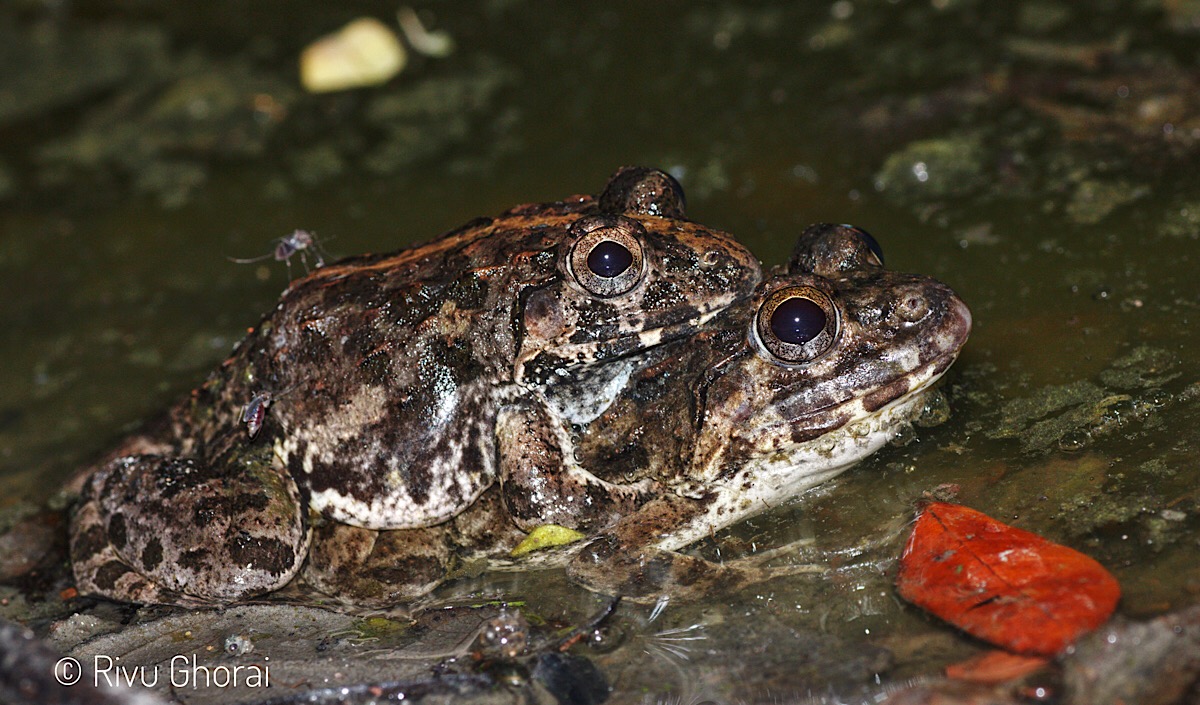
Overall I would say I am very much impressed by the diversity that I found in the factory. Frankly speaking, I never ever thought that I would find so many different species in the factory.