Showing posts with label reptile. Show all posts

Saturday, March 21, 2020

Turtle keeping hobby and environmental impact

For the last few years, keeping turtle as pet is growing in popularity. It is now easier to contact the bulk seller abroad through social media. So it has become easier to import tiny juvenile turtles of different types. For this reason it is now not only limited to big fish seller only. Now small amateur sellers can also import and sell on their own. This trend is picking up speed. So now we can often find individuals selling turtles in social media platform at very attractive prices as they dont have to bear the extra cost of setting up shop as professional sellers. So this benefits the turtle lovers. They now get quality turtles at reasonable rate. Mostly the Red Eared Slider turtle is available. Then with patience one can find Yellow Bellied Slider too. A few times I have seen Common Snapping Turtle and Alligator Snapping Turtle on sell in Kolkata. Turtle keeping is a very rewarding hobby. The little turtles that are on sell hardly measures 2” in diameter. One can not deny they are too cute to resist. But everyone who ends up buying a turtle do they all really know what the are getting into? What is the environmental effect of this increasing trend of turtle keeping?


First lets find out what are the requirements of a turtle. We will mainly talk about Red Eared Slider (RES). A RES is a native of Southern United States. They are sold at generally 2”-3” in size. Though, their adult size can be upto 16’ in size, their average size is about 6’-8’ in diameter. They live for approx 20-30 years. They are semi-aquatic species. So they need land as well as water to survive. Turtles have their body covered with bony plates which protects them from predators. These plates are made of bones. So they need to sunbath to sock UV-A and UV-B rays for the proper formation of their shells. Otherwise their shell will get deformed which will lead to various health problems. They also need sunlight to regulate their body temperature as they can not generate their body heat as us. They are found big water bodies like pond, swamps, slow moving river etc. They eat everything. Adults are more of a herbivore. But they are very messy eaters.


So what does these all mean to a pet keeper, a person who walks into a pet shop or sees a sell post in social media, a tiny turtle overdosed with cuteness, which compels him to buy one? He should see a responsibility of 20-30 years. And he should also realize that this tiny little turtle will not be this tiny always. It will grow to be atleast 6”-8” in size. Most people here keeps a 2’X1’X1’ tank at home. That is the most popular size. It holds roughly 15 us gallons of water or 56 liters of water. It is okey for a juvenile turtle to start with. But soon a adult RES will need at least a 80-100 us gallons tank for a single individual.this requires a very large tank approximately 5’X1.5’X2’ in size. Feeding them is not a problem as they accept all kind of food readily. Now you can buy a good quality turtle food readily available in the market. But as they are a very messy eaters they create a huge amount of food waste. So you need a very high capacity filtration system which turns the water 5-8 times per hour or you need to water change everyday. They also need a platform outside water level where they can sunbath to maintain their body temperature and proper growth of their shell. For this a full spectrum light and a UV-A UV-B light needs to be installed. Otherwise they will face health problem. Human can also face health problem from them if their environment is not kept clean. All turtles carry Salmonella bacteria. In a dirty turtle tank there is high chance of it to cause Salmonella poisoning in human associated with the turtle. For this reason selling of RES is banned for pet trade in Australia, USA and many other countries. Now if you want to keep any other turtle, increase or decrease the aquarium size in the relation of the adult shell size of the turtles with respect to RES. You will get a general idea. So if you want to keep turtle as pet, you should be ready to provide all these to it, then only it will be able to enjoy to live a happy life and you will be able to enjoy your turtle to the fullest.


But do everyone who buys a turtle provides all this? What happens when they find out that it is too much responsibility for them? Or may be this turtle is not so tiny and cute anymore? This usually leads to two things. Either the tiny little turtle dies a premature death because of poor husbandry  in their first few months or they survive all the odds somehow and eventually grows to be a adult turtle. RES is very hardy species. That is why they are so popular in pet trade. If they survive their first 1-2 years, they generally live their full life. So when they out grows their small tank, they are now not so cute and tiny, most of the irresponsible pet owners release them in the wild. This causes very serious environmental impact.


These turtles come to maturity in a relatively early stage at 5-6 years. So they take less time to start breeding. They are tough, well protected and omnivore, so they adopt to different environment very easily. These traits have established itself in many places in the world decreasing the local turtle population. This way it has made its way in the IUCN list of ‘Worlds 100 most invasive species’. Many states of USA has banned its import. Australia, Japan and many other country has also banned its import. Queensland province of Australia alone has invested $1 million AUD for eradication of RES.


Situation in India is not that bad until now. But it has definitely started to worsen. A researchgate paper reports of sighting of RES in Goa in a state wide survey done in June, 2012- December, 2015 time frame. Deccan Chronicle of dated 07 November, 2016 reports that many RES were spotted in the lakes of Hyadrabad. An academia.edu paper reports of a RES sighting in Malan river near Bhavnagar, Gujrat on 10th August, 2014. A article in babushahi.com report about a RES sighting in Sukhna lake, Chandigarh on 12th March, 2016. In our state West Bengal, in a article in thebhs.org dated 3rd November, 2018 reported about a RES sighting in Rajarhat Wetlands, Kolkata on 19th August, 2015. On 16th January, 2020 Tirthankar Roy posted in a few Facebook group about RES sighting in Rabindra Sarobar lake, Kolkata.


There could be many more sightings in various parts of our country. These are just a few that came upon a quick google search. In Kolkata thousands of baby turtles are now imported from China and South East Asian countries. Most of these will die in the hand of ignorant pet keepers. Those who survive, a part of them are kept by the responsible keepers, others are dumped in the local pond or lake. Then they become invasive. The responsibility lies on three persons shoulder. Firstly the pet keeper, we have to know all about them and will have to decide if we really can take proper care of it for its life time ie. 20-30 years. Only then we should go ahead. Second person is the seller. They should inform the buyer properly about the care and responsibility of keeping this turtle. Instead of that in most times the seller misguides the buyer that the turtles will stay this small and it is okey to put them in a fishtank. The third person is the government. They have to make a proper guideline to restrict the trade otherwise at this rate it will not take long for us to loose some of our native freshwater turtle species from the wild due to pressure from RES and other exotic turtle species.


This popularity in turtle keeping has created another problem in sub-urban areas where exotic turtles are mostly unavailable. There sellers are selling baby soft shell turtles and other native turtles to keep in aquariums. This is illegal. Keeping an exotic species of turtle is still not illegal in our country but keeping any native turtle is illegal. All the native turtles are protected under Indian Wildlife (Protection) Act, 1972. So buying, selling, keeping or eating any native t
urtle species will attract an imprisonment of 3 years or fine of INR 5000 or both. So people who are thinking of keeping a native turtle as pet, please dont. It can cause you serious legal problem.


***all the images are collected from internet. copyright of the images are with their rightfull owner. these are used only for educational purpose.

Monday, March 16, 2015

Killing Tides

India represents 5 species of sea turtles i.e. Olive Ridley, Green Turtle, Hawksbill Turtle, Loggerhead Turtle and Latherback Turtle. Of these, except the Latherback, other four are reported from the coast of West Bengal. The sea turtle habitat of West Bengal is represented by a 50km coastline of Purba Medinipur district and the sea facing islands of Sundarban Biosphere Reserve. The coast line of Purba Medinipur is a densely populated area with no forest cover except the casurina plantation in a few areas. So the area is not suitable for sea turtle nesting. Thus only a few individual nests were recorded over the years. The sea facing islands of Sundarban are devoid of any human habitation, and has good forest cover with sandy beaches. They are protected areas also. So, these islands harbor a few hundred nests each year. Only Olive Ridley nests were reported from West Bengal. Thus we can see that the whole coastal zone of West Bengal don’t have much nesting activity. But still it is an important turtle habitat mainly for Olive Ridleys mainly because of neighboring areas. Within 100kms from this here is Gahirmatha Rookery, which is one of the few mass nesting site for Olive Ridley turtles in the world. Thus the coastal water of West Bengal see much turtle movement from September-October to May-June.


The sea turtles of this area have always faced many threats. Some of the most severe threats were the commercial trade of turtle meat and eggs and incidental trapping in fishing nets. Though the activities of forest dept have much reduced the commercial trade of turtle meat, this trade has not stopped totally. Turtle death due to incidental catch in gill nets of trawlers has not reduced much. To reduce catching, forest dept has restricted trawling in few protected areas. Coast guard has also started patrolling from 1990. TED (Turtle Excluder Device) has also been introduced to reduce the no of death. But for various reasons, TED has not seen much acceptance in fishing communities. Thus most of the vessels don’t use TED in their fishing nets. So turtle get struck in fishing nets and eventually die. As the commercial trade of turtle meat is banned, the fishermen through away the dead turtles in the sea. These turtles wash up ashore. In the nesting season, the coast of West Bengal and Orissa fills with dead turtles.


As the commercial trade of sea turtle has shown a declining trend, we should also try to reduce turtle death due to incidental catch. All the 7 species of sea turtles that are found around the world are facing the danger of extinction. Though Olive Ridley is one of the numerous species of them, this does not mean they are not in danger. The coast of Orissa, the neighboring state has some of the few mass nesting site of Olive Ridley in the world and the costal water of Orissa also faces the same threats that the costal water of West Bengal faces. So, we should look for ways to minimize the threats for sea turtles otherwise they will go extinct like many other species.

Thursday, February 5, 2015

Turtle Meat Trade

Turtle and tortoises are fascinating creatures. They have amused us with their appearance and behavior from ancient times. That’s why they were depicted in cave paintings and folklores. In Hindu Mythology, Lord Bishnu had an incarnation as a turtle. And in another literature we find mention of a turtle on whose back the earth is resting. In Aesop’s fables of ancient Greece, we find a story of a competition between a turtle and a rabbit. Turtles are kept in ponds and water bodies besides Hindu temples as good oman. Not only in folklore and religious texts, turtles have been mentioned in Ayurbeda medicinal practices. Turtle meat and eggs were relished by people from old times. But none of these have become the reason for their near extinction until the commercial trade of turtle meat has gained ground.

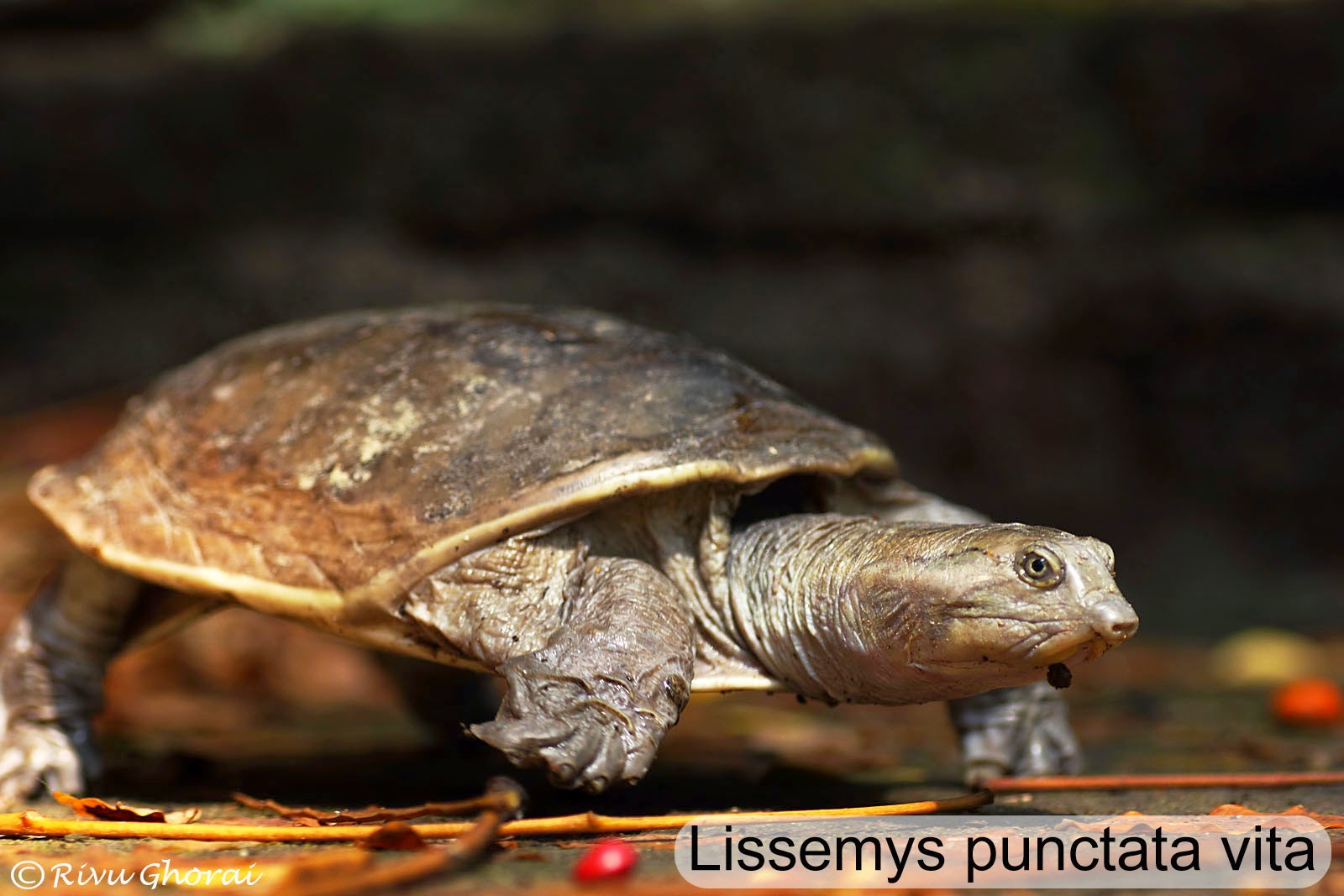
Of the 26 species that are found in India, 22 are under commercial pressure of various magnitudes. But the species which faces the maximum pressure is Indian Flapshell Turtle or Indian Mud Turtle (Lissemys punctata). It has three sub-species in India. L. p. punctata is found in Kerala, Tamilnadu etc states. L. p. andersoni is found in Pakistan, North India, Southern Nepal, upto Bangladesh and Mayanmar through Brahmaputra valley in the east. L. p. vita is distributed from southern Gujrat through Karnataka, Andhrapradesh, upto Orrissa in the east. So it seems the turtle is distributed in whole India except the state, Kashmir. Also as it mostly stays in areas near human habitation, it is one of the most popular turtle too.

The main reason of its wide distribution is its choice of habitat. It is a generalist when it comes to the choice of habitats. It is found in various type of wetlands like river, canal, pond, lake, paddy field even in drains, manholes of many cities. Though it is a fresh water species, it can bear with moderate level of saltwater. That’s why it is also found in estuaries of Sundarban, Bhitarkanika, Kuringa etc places. But it prefers swallow waters. It is also a generalist in terms of prey preference. Its food list includes frog, tadpole, fish, earthworm, crustaceans, molascs, waterplants, and many other things. It also scavenge on dead bodies and keep water bodies clean. Like many other reptiles, turtle also hibernates. In North India hibernation occurs between November and February. Another very interesting behavior seen in these turtles is aestivation. In summer months, if the water body dries up, they leave it and find another one. But if drought has dried up all the water bodies then these turtles aestivate inside mud. Many times this behavior proves to be a life saving one. Time of mating differs in these turtles locality wise. But everywhere it is related with Monsoon. Generally in North India, mating occurs in the month of April-June and egg laying occurs in the month of September-November.  An average clutch contains 9-15eggs. Incubation period is 270-350 days.


Commercial harvesting and selling of turtles has not gained much popularity until the seventies. Turtles were exploited but in a local scale. Mainly the fisherman folks were involved in this. But after seventies the situation changed rapidly. A racket came into play for commercial harvesting and selling of turtles in various places. All species of turtles were exploited but mainly Asian Giant Softshell Turtle, River Terrapin, Gangetic Softshell Turtle, Indian Mud Turtle were exploited most. The first two species are almost extinct in their natural habitat because of this commercial pressure. Now the other two species are mostly found in market. In this trade, Howrah has become one of the main trade center from the beginning. Turtles were transported here from Andhra Pradesh, Orissa, Jharkhand, Bihar, Uttar Pradesh and Assam. Previously train was the main transport option used by this trade. It was easier to hide the turtles in fish parcels. This trade has peaked in the eighties. In 1991, forest dept has seized 4448 turtles from Kolkata of which 4053 were Indian Mud Turtle. 2926 nos of turtle were seized from Kolkata in 1992 of which 2732 were Indian Mud Turtle. In an average approximately 50-60 thousand turtles were sold in Howrah market alone every year. Later by the activeness of Forest Dept turtle meat trade has gone underground. The main market has now shifted from Howrah to sub-urban areas and Bangladesh border. The transportation system has also shifted towards Bus and Truck. This has somewhat reduced the size of the trade, but it did not stop the trade all together. Till now trucks are seized in various parts of India carrying turtles.


Indian Mud Turtle enjoys the ‘Schedule I’ protection of Indian Wildlife (Protection) Act, 1972, which is the highest protection in our country.  Though, only legal protection has never saved any species from extinction. One bright side of its wide distribution is that many National Parks and Sanctuaries are within its range which will protect a healthy population of this species. One very interesting fact is that in spite of this severe pressure from commercial exploitation, this turtle has hold its ground in almost all its range. Still it is a ‘common’ species in most of its range. Now only time and our actions will tell how long can it retain its ‘common’ status, or become extinct in its natural habitat just like River Terrapin.

Thursday, January 16, 2014

New Year Gift ( Yellow Speckled Wolf Snake)

This day I got a call from a friend asking me if I would collect a snake they have captured or would they kill it. And I certainly told him to keep the snake for me. Then I asked him about the description of the snake and came to know that it is a green snake with spots on it. I was not sure which snake it was from the description but as it is not similar to any venomous snakes found here locally, I told him, “it is probably a non-venomous snake but still don’t touch it.”

This conversation happened in the morning and I was told to pick up the snake in the evening. The whole day I was thinking about the snake but could not decide what it could be and in the evening when I received the snake, reality exceeded all my expectations! It was a small snake, approximately 12”-14” long with brownish green back and white belly. Moreover it had two yellow spots on each scale. And I shouted in joy, “it’s a yellow-speckled wolf snake!!!!” whenever I saw its photo in books and various online groups, I wished to see one in real life but its distribution is so limited that I never thought I would see one ever, that too in my hometown. It was 2nd January and all I could think was that this was the best new year gift ever.

Yellow Speckled Wolf Snake ( Lycodon jara ) is a non-venomous snake found from West Bengal, Arunachal Pradesh and Ganjam district of Orissa in India and also from Nepal and Bangladesh. The maximum length recorded is 22”. It’s a smooth scaled, slender bodied snake. The head is slightly broader than the neck like all other wolf snakes. The upper side varies from glossy brown to purplish black. Belly side is white in color. Almost all the scales on its back have two yellow spots on them and thus the name. Sometime the spots are white in color. Very little is known about this snake. Only that it is a nocturnal snake and it eats geckos.
From my personal observation I found that this snake prefers corners and crevices than open place. Though it is a nocturnal snake, given a choice to stay between a dark open place and a bright corner, it feels more secure in the corner. It also hides its head slightly under its body coil like a few other wolf snakes. “And unlike the Common Wolf Snake, not tempermental and usually does not bite when handled.” Though the previous line was written for a few other wolf snakes like Barred Wolf Snake in the book ‘Snakes of India, The Field Guide’, I found it perfectly suitable for this one too.

When I released it in my own front yard, it was very quick to vanish from my eye and I am sure not to see it again ever though it is just in front of my house. Snakes have evolved to stay hidden so good that we often don’t realize how many snakes are there around us. That is infact in the benefit of both of us. Otherwise we would have killed all the snakes if we had the chance, or atleast that is the mentality of many of us. But it is good to know that people are changing. Thank you Utpal Das for this wonderful new year gift.

Saturday, November 16, 2013

Snake Dancing dilema

For the last few years, I was getting information about an age old tradition of snake dancing on a particular date of year but could not locate the place or date in specific. This year the situation was different. Few of my friends have already got the information and asked me if I am interested to go with them or not. I had no reason to reject them, so I hopped on their bike and off we go.


It was a very interior village and I am not disclosing the name because I don’t want to promote this practice. Anyway when we reached there, first we located the people who actually do the performance. By talking with them we came to know about many things. This snake dancing on the occasion of Lakhsmi Puja (a celebration of the goddess of wealth) is almost 150yrs old. All through the rainy season they catch the snakes in and around their village. And they only catch Monocellate Cobra and Spectacled Cobra because of their spectacular hood display. Then on this occasion, they perform the snake dancing for 3 consecutive days and release the snakes in the nearby river. (well, I was skeptical about how many snake will survive after the release.) Just before the ceremony, the organizers have emptied the venom glands of the snakes by making them bite repeatedly into papaya stalk. This way the dancers will not have to worry about the bites they may receive during the show.

At the scheduled time they transferred all the snakes to a small stage that was set in the fair ground. Each snake was in its own earthen pot. There were total 30-40 snakes of various size and age group but all are mostly adult only a few sub-adults. Then they started the show. There were 3-4 performers on the stage and a few other men to assist them. Performers were bringing out snakes one by one, played with them a little bit, then put it into its pot. It was a modest show. The music was deafening. A big crowd had gathered around the stage and they were very enthusiastic. Dancers were playing with 1-2 snakes at a time. Even I noticed to get bitten a few times but they didn’t care. This went on for approximately half an hour and came to an end.

One thing struck in my mind, most of the snakes were injured. They have injury on their head and several places on their body. If this is the type of performance that I saw was going on, then they don’t have any chance of having that extent of injuries. When I expressed my concern to my friends, they showed me the pictures from the first day of the event. This took me by surprise.

People are holding 5-8 snakes together over their head. Snakes are biting each other ferociously; they are biting the performers also. Blood was seen everywhere. The performers were even seen rolling on the stage over the snakes, which is severely dangerous for the snakes. I was wondering how this could go on un-noticed by the forest dept. Then from a member of the organizers I came to know that forest dept had stopped the program for 3 years in the past. But like all other activity in our country, they had made some arrangement with the local forest dept. So I guess this will go on for another few years in the future.

Sunday, June 17, 2012

10 points to avoid snakebite


As the rainy season is approaching, the interaction with snakes is about to increase for everyone. But as it is not desirable for most of us, a simple few steps could help us avoid them altogether. It will also save many lives of both men and snakes.

Conflicts with snakes mainly happen at two places, inside the house and outside the house. Let us first understand why snakes enter houses. Snakes enter mainly for two reasons, to hunt and to take shelter. Snakes often enter houses to hunt for rats, mice and toads that take refuse in our houses. Another reason is taking shelter. Snakes, like other reptiles go into hibernation, i.e. a long period of inactivity, for 2-3 months in the winter season. So they look for places where they can safely hibernate and keep out from the winter chill. The same thing happens in summer too. To beat the heat they try to find a cool shaded place to aestivate. In nature snakes seek out places like underground tunnels, under fallen trees or brunches, under big stones etc. human homes offer perfect alternatives of these in the form of cluttered corners, unused rooms, under the stairs, behind the almirah etc.


And out side the house conflicts happen when people accidentally step on them or go near them. Snakes generally hunt in the morning and evening when the temperature of the atmosphere is moderate. In the noon, when the temperature is high snakes take rest under dry leaves, under fallen logs, inside holes in tree trunks, under the exposed roots etc.


So if we sum up the points, it will go like these.

  1. Free our homes from rats and toads by using poison, traps, hand picking etc.
  2. Clean the house and neighborhood and see that no garbage is staying for too long like pile of bricks, heap of firewood etc.
  3. Snakes don’t like the smell of carbolic acid, bleaching powder etc. so using these around houses can reduce incoming of snakes.
  4. People generally get bitten at night because they don’t see the snake in dark and step on it accidentally. So using a flashlight in snake infested areas in the night will reduce snake bite.
  5. Generally people get bitten on the foot. So using a ankle high shoe can reduce snake bite also.
  6. As snakes take rest under exposed tree roots, under heap of dry leaves etc, we should be careful when passing them or stepping on them.
  7. In the harvesting season snakes gather around the fields to hunt rats because rats gather in great numbers to collect food grain. So be careful when roaming in the field especially in the harvesting season.
  8. Snakes generally bite only when it is cornered. So if you accidentally come near a snake, give it room to escape and it will escape at the first chance.
  9. Most ground dwelling snakes don’t have very good eyesight; they feel our presence through vibration on ground. So in front of a snake, if we stay still, it wont be able to recognise our presence and eventually it will go.
  10. Snakes like the warmth of our body and blankets and hide in our beds. As a result, many people get bitten while they are sleeping and if the bite is from a Krait, you wont even feel the bite. So always check the carefully before going to bed and use a mosquito net.

You see these 10 points are no rocket science. They are just general awareness that we need to maintain. And you will be surprised to see the result of it. It will surely lower the chance of getting bitten by a snake. So keep safe and enjoy monsoon.

Tuesday, April 24, 2012

Tragic Hero (Ornate Flying Snake)

People fear snakes. And writers have manipulated this reaction from ancient times. As tragedy is more interesting than comedy, fear is also more interesting than love. So writers have stitched false information about snakes in their stories to create a fearful atmosphere. One of the classic examples is the ‘Manasamangal’.

It is a classic Bengali story of a businessman and his family who was involved in a conflict with the goddess of snakes, ‘Manasa’. This story tells that Manasa sent a very deadly, very venomous snake, ‘Kalnagini’ to kill the youngest son of that businessman. Now as most of the people don’t read science journals but they have read or heard this story at least once in West Bengal, they regard Kalnagini as a very dangerous snake capable of killing human being with its venom. And I can’t blame them for that. Nobody has ever told them otherwise.

Now what the truth really is?? What is this infamous Kalnagini? Kalnagini or Ornate Flying Snake (Chrysopelea ornata) is a very beautiful and handsome snake. As like every other tree snake, it is also slim and long, average length 1.2m . Overall coloration is greenish yellow or pale green above with black cross bands. Scales also have black borders. Every alternate cross band has reddish or orange patches in vertebral area. The head is black with white and red patches. This is a diurnal and arboreal snake, meaning it is active in daytime and it prefers trees and bushes than grounds. It generally feeds on frogs, lizards, small mammals, birds and even bats. Ornate Flying Snake is not very choosy in its diet and eats whatever it can capture.


And about its deadliness, Ornate Flying Snake has elongated, grooved teeth for delivering the venom. It falls under the category of ‘Rear Fanged Snake’ because its elongated teeth are at the rear of its jaws unlike other venomous snakes which have these at the front. Most importantly, it has very mild venom to subdue its prey but which is totally ineffective against the human. IT CAN NOT KILL A HUMAN. Only side effects like allergic effects, numbness of the bitten area etc can happen.

Being non-venomous or correctly say mildly-venomous does not make it any less interesting. It has a very unique characteristic which only a few other snake poses. It can’t fly but it can glide in air 50m-100m depending upon the height it jumps from. It flattens its body, hollows out ventrally and jumps at an angle with respect to ground. Flattened body helps it to glide through the air and by swinging its tail, it can control the direction of glide. Isn’t that a great achievement for an animal which doesn’t even have hands or legs?

Now come back to the story of Manasamangal again. I would not say the writer didn’t know it is a mildly-venomous snake. Rather he used this snake for this particular feature. No venomous snake would serve his purpose. In the story, after the youngest son got bitten by Kalnagini, his wife took him to heaven and pleased gods by singing and dancing to return his husband’s life. What if she didn’t do it and stayed home? It would have brought the same result. Her husband would not die in either case. You see why I said the writer choose this snake purposefully? Because if any venomous snake had bitten him, even the gods would not be able to save him without the antivenin. And this also the reason why snake charmers can successfully heal people from snake bite sometimes.

Sunday, February 12, 2012

Super cobra in the making...

A few days back I went to a friend’s house but she was not home. So I was chatting with her mother. As the topic of snakes came along, she told me a very fascinating story.
2-3 years back, one morning one snake was spotted in their locality. There was a medium sized water tank with water and the snake was in it. When they identified it as cobra, they called a snake charmer. Even he could not catch the snake because of the water, so people decided to kill it. After beating the snake severely with sticks and rods, they put the snake on ground. And suddenly the cobra regurgitated another snake. And guess what, that was a cobra too. The first cobra was approx 4.5ft long and second one from 3-3.5ft.


Now this was interesting for me because I have not heard of cobras feeding on cobras or any other snake previously. So I started to look for material on this subject. King cobras and Kraits are known to feed on snakes but could not find anything related to cobras. Then suddenly I stumbled upon a image in an online group, Indian Snakes. It not only proved the previous story, the comments gave a whole array of information.


The photo was originally posted by Mr Rajeevan Shri in another group DiversityIndia. And this was the supporting text “While travelling through country side around Quilon found this. People beaten the cobra very badly it was dying when the pic was taken' cobra was about 5feet long &viper about 3.5feet long. Taken 1998 Dec.” Now when I went through the comments I saw that one person says that he has seen a cobra feeding on a daboia before and this is the second time he is seeing this. Another person says that he saw a cobra vomit a daboia before while his friend was rescuing the cobra. And one person added even more interesting fact. He has seen cobra feeding on rat snake and even a rat snake feeding on trinket snake.

These could be some very unusual individual incidents or these could be showing a trend. The snakes, especially the cobra may have started to change their feeding behaviour. An easy conclusion could be drawn that the scarcity of prey species have forced them to target different species but their main prey, the rats have flourished with the human very well and are not scarce. May be inter species competition is forcing the cobras to be superior than the daboia and feed on that species. Well, these are just my imagination and the real reason could only be found by scientifically investigating the whole matter.

Friday, January 27, 2012

cry of the crocodile ( Gharial)

This time when i visited Alipur Zoo, i again met with these magnificent reptiles called ‘Gharial’. Though i have already seen them at Madras Crocodile Bank a few years back but they don’t fail to amaze me with their uniqueness. They have a typical long and slender snout that no other crocodile have. Moreover they have a swelling present at the top of male’s snout which people relate to ‘ghara’ or earthen pot. That is why it is called grarial. They pose no threat to human still they are endangered and rare in throughout their home range.

Gharial (Gavialis gangeticus) is the oldest of the crocodiles. They were found in the river systems of Ganges, Irrawardy, Indus and Brahmaputra within the borders of India, Nepal, Bangladesh and Pakistan. But currently they have only two viable breeding populations at National Chambal Sanctuary in India and Chitwan National Park in Nepal. Other few fragmented population can be found in a few places but they don’t breed. Several factors are pushing them towards extinction like poaching, egg harvesting etc but none is as destructive as habitat destruction. These crocodiles are typical habitant of rivers. Building dams on rivers dries out the river in downstream side of the dam. As this creates a shortage in fish population, the gharials face starvation as they are totally dependent on fishes. They occasionally take turtles, birds or corpses but fish is their main prey. Even among fishes, gharials prey upon predatory fishes. Where ever the gharial population has decreased in size, local Fishermen have witnessed a decreased in their fish catch as increase in predatory fish decreases the number of edible fishes. In the upstream section of the dam the problem is different. Here water floods a huge area submerging the sand banks and river islands crucial for gharial nesting. Though gharial population have increased in number from 240 in 1974 to approx 2500 now but still there is a possibility of extinction as there are only 20 breeding males are in wild. Males reach maturity at a length of 3m and an age of 13-14yrs. Females reach maturity at an earlier age, at 2.5m length and 8.5yrs of age. They can reach a maximum length of 6.75m and have lived for 29 yrs in captivity.

A captive breeding and rearing program have been initiated. Gharial eggs are hatched in artificial hatcheries and then released back into wild habitats. This is seeing a bit of success but without protecting its habitat it won’t take us long to witness the extinction of another marvellous animal.

Sunday, November 27, 2011

Deadly affair (common indian krait)

On this evening, I was browsing internet in my room, suddenly I heard some people talking about some snake. It seemed like somebody have spotted some snake. So I grabbed a light and rushed to the spot. 3-4 people have gathered in front of the house beside our house. They told me that someone saw a black snake when she was entering the house and came out of the house. I thought it would be common wolf snake as always. I entered the house. It had a small varandah at the entrance and then there is the gate is the gate of the bedroom. One side of the varandah was filled with coconut, what an ideal place for a snake, and the other side had some bricks stored. After a while, fortunately i found the snake in the brick stack.


I was surprised. I never imagined it to be a krait and there it was a common Indian krait waiting behind the bricks. This is my first krait sighting. I quickly told the people to get a strong stick and get some more light. I secured the head with stick and was about to catch the snake, suddenly a over-enthusiast man showed up with a big log in his hand. He didn’t hear anybody and straight tried to kill the snake. I was in an awkward situation. With one hand I was holding the stick with which I had secured the head of the snake and with the other hand I was trying to cover the blows made with the big log. The most terrifying thing was that the snake is no ordinary snake, it is the most venomous snake of asia. After a few blows the man paused for a second and I quickly captured the snake and started walking straight to my house. I put it in a plastic jar and kept it in a secure place.


Common Indian krait or Bungarus caeruleus is a nocturnal snake. In the daytime it is a very lazy and timid snake but at night a sharp contrast in behaviour can be seen. It becomes very active, alert and dangerous. In the daytime it generally rests in termite mounds, rodent burrows, stacks of bricks, rubbles or even inside household items like rolled up carpets. This snake is so well adopted in various habitats that it is found in almost all of India except Kashmir and Arunachal Pradesh. It is mainly found in fields, low scrub jungles and even in marshy lands. It is also found near human habitation and often enters inside houses. This particular behaviour makes it more dangerous. Some time people get bitten unknowingly when they are asleep. Their bite is not as painful as cobra or viper bite but it is far more virulent than the two (it is 15 times more potent than the cobra). Its venom is both neurotoxic and heamotoxic. It is the MOST VENEMOUS snake of India. Bite from this snake must be treated at hospital with antivenom serum. Otherwise death will come in 5 to 12 hours. Symptoms are like cobra bite, drooping eyelid, severe abdominal pain, vomiting and respiratory problem. Usually the cause of death is respiratory failure.

It is a cannibalistic snake. It usually eats other snake often of the same species. It also eats frogs, lizards and mouse. It attains a maximum length of 1.73 m but average size is 1.2m. the specimen i caught was around 1m in length. May be due to their cannibalistic nature at the time of mating, they first carry out an examination of each other and then settles down together. Mating occurs in February- march. Kraits also stay with the eggs like the cobras.

After a few days I planned to release the Krait. But finding a suitable place was a real headache. There was no suitable place remote enough to release the snake. I had to travel 30km to find a place for the releasing. every day more and more lands are being converted into farmland, commercial land or residential area. Snakes and other life forms are finding it hard to find an unused patch of land which they can use as their safe refuse.

**One interesting fact I would like to mention. On my journey of 60 km, I found atleast 14 dead snakes, all are road kill, run over by cars. 6 of the snakes are olive keelback water snake, 4 are chekered keelback water snake, 2 are buff stripped keelback land snake, 1 is a rat snake and the other one was not in identifiable condition.

Friday, October 14, 2011

Hidden Jewels (skinks)

When the question comes about reptiles, we mostly don’t know the answer only because they are the most neglected one. People care about birds, people care about mammals but people don’t care about reptiles except the fact that people fear snakes. And among reptiles the most neglected ones will be the skinks. Leave aside the common people, even the experts don’t have much information about them.

Of these greatly neglected, less studied and very secretive animals, two species are found at my home town Tamluk, Purba Medinipur, West Bengal. The first one is the most common skink of India, Brahminy Skink or Keeled Grass Skink (Mabuya carinata). It has a robust bronze brown body with 2 lateral yellow stripes and a chocolate brown band on top. The legs are well developed. It grows upto a length of 290mm of which 170 mm is tail.

This skink is equally at home in rural as well as urban environment. It frequently enters houses in search of prey. It mainly feeds upon crickets, caterpillars, beetles, earth worms etc. Though skinks are mainly ground dwelling creature, it is a very good climber also. I have seen it climb 6’-8’ vertical cemented wall with ease. And it is so good at living in urban space that i found 2 specimens in our 2nd floor rooftop garden.

The second one is the Snake Skink or Supple Skink (Lygosoma punctatus). Very few have seen it partly because of its small size and partly because of its semi-fossorial living. Semi- fossorial means it spends its time both over and under the surface. For its underground living habit several changes have occurred on its body. The body is elongated and have a snake like appearance. Legs are very small compared to the body. This gives us a hint how snakes have lost their legs. And the lower eyelid has a transparent window. This enables it to see even when the eyelids are closed which is often the case in underground movements, to protect the eye from accidental scratching.

Other than these, its general coloration is brown above and yellowish white below. It can reach a length of 15cm of which half is its tail. Tail is rather thick and gradually tapers to a point. As it spends most of time under leaf litter, it is hard to see. One interesting fact is that, the colour of the tail of juvenile Supple Skink is bright red. It looses colour as it ages.

Saturday, July 23, 2011

Non-paying guest.. (Garnot's Gecko)

For last few days I was thinking about which reptile should I write on. I didn’t have any wildlife encounter lately. Suddenly a “tick, tick, tick, tick” noise from the room’s wall caught my attention. Two lizards were fighting for territory. That opened my eyes. These lizards are with me every single minute and still I have ignored them till now.

So I opened my guide books to identify the lizards but could not identify them exactly. Only learned that it is kind of a house gecko. Then I got a call from my friend Gudduda. He told me to pick up one book from College St., Kolkata. It was a field guide on Indian reptiles by Indranil Das. I thought may be that can help me. So I rushed to get the book as soon as possible. And yes, this book exactly identified it as Garnot’s Gecko (Hemidactylus garnoti).


This little lizard is very numerous in our area. Each room of our house contains 2-3 individuals at least. They are rarely seen in daytime. Generally hides behind cupboards, bookshelves, cracks on walls or inside ventilators. But as the sun sets, they come out to hunt. Like all other hemidactylus species or rather say geckos, they also maintain individual territories. But where food is numerous like around light bulbs, they don’t maintain territories and gather around to reap the bounty. They are carnivorous. Their main foods are insects, spiders and insect larvae. They eat a great number of them daily.

This gecko grows to about 7cm in length from snout to vent. The tail is about 5-7 cm in length. Tail can break at will and this gives it a opportunity to evade the predators by distracting them. It has a large head. The scales on back are small. It also has lateral denticulation on tail. The overall coloration is brownish grey. Belly is of cream colour.


There are a few very interesting facts about this particular gecko. The first one is about distribution. It is a very widespread species. In India, it is found in Eastern part including West Bengal, Sikkim and Assam. Internationally it is found also in Bhutan, mainland South-east Asia and upto the islands of Pacific Ocean. But locally it does not share space with any other gecko. In our area three species of geckos are found, Garnot’s Gecko(Hemidactylus garnoti), Northern House gecko (Hemidactylus fluviviridis) and Brook’s Gecko(Hemidactylus brookii). The northern house gecko is most numerous. I have seen northern house gecko to roam side by side with Brook’s gecko. But I have never seen anyone with Garnot’s gecko. Locally where these two are found, the Garnot’s gecko stays missing.

Another interesting fact is about their breeding habit. There have never been any record of the male of this gecko. That means the whole population consists of only female geckos. Parthenogenesis is not very rare in reptile world. It is the process of producing offspring with out the need of mating or male sperm. These geckos produces two oval shaped eggs per clutch without mating with males.


Some people consider geckos to be harmful. But this is only a misconception. Actually geckos do a great amount of good by eating insects. Also geckos are not poisonous. Only three lizards are poisonous , 2 lives in north America and 1 in Comodo Island. So, that means my article name is also a misnomer. It is actually paying me by providing pest control services..

Thursday, May 13, 2010

Olive Ridley hatching in Orissa

‘ARIBADA’ it may sound wired to some people but it is one of the most extra-ordinary incidents that happen in our natural world. Every year thousands of Olive Ridley turtles come to 3 beaches of Orissa, India in the month of January for laying eggs. This is called ‘Aribada’.

The eggs hatch in the month of May. This year I and 2 other folks went there to see the hatchlings. We get off the train at Chandrapur and from there it was a half an hour journey into the interior of Orissa. The beach of Puranabanda is a very remote beach far from the chaos of tourist and all that. It is actually a fishing village of Rushikulya. We stayed with our host society ‘Rushikulya Sea Turtle Protection Committee’. There is no other option for staying overnight for now. The people there are very much friendly.

In the next day morning we went to the beach to see the turtles hatch. The beach had protective fencing put up by the Forest Dept. When we went inside there was nothing. One or two people like us, some small local boys and three four Forest Dept. workers were there. But one thing was numerous, the crows. And in-spite of the fencing, 2-3 dogs have entered the area but no sign of the turtles. So I started to follow the dogs. Suddenly I saw a dog picked up something dark from the ground. I rushed to the area and oh! there it is, a small baby turtle. And as I was concentrating on the single turtle, several others have come out of the nest. That was the start. After that we found numerous nests from where the babies were emerging. They were just every where. But just near the tide line where the nests got exposed by the sand erosion of the sea waves, the eggs were not so lucky. More over there were predator everywhere, crows, black kite, brahminy kite, stray dogs, crabs all were ready to make a feast with the turtles. For that reason the forest dept has hired workers to collect the hatchlings as soon as they emerge from the nest and release them at the sea shore to minimize the chance of predation. But the solution is not very perfect, there we meet a researcher from USA who was worried seeing this technique. In her words the babies imprint the location of the nesting beach in their head at the time when they crawl from nest to sea. So if they don’t get a chance to crawl they might not remember the location. What we came to know about the mortality rate of these turtles is that only one in a thousand survives to become adult!!!! Well, now they have emerged from the nest, immediately they start to crawl towards sea. Generally they hatch in the night. So, how they navigate to the sea?? It is also interesting. They follow the reflection of the light of the stars on the sea. Experiment shows that they follow any source of light. That is why any kind of light is banned on these beaches in the night, because they can mislead the hatchlings. They may look like clumsy but they are pretty fast crawlers. When they reach the se shore they are washed away with the waves into the sea. There they began the real journey of there life. When they will mature, the female Olive Ridleys will come back to this same beach to lay there eggs only if the beach is still there for them. It is our responsibility to save this habitat and the turtles, which is already claimed as critically endangered if we want to witness this wonder of nature times and times again.