Showing posts with label venomous snakes. Show all posts

Tuesday, February 4, 2020

How to differentiate between Russell's Viper and Rock Python

Day by day Russell”s Viper(Daboia russelli) is becoming the most medically important snake for Eastern India. So it is very essential to identify this snake properly and do not confuse it with other similar snake like Indian Rock Python(Python molurus), which is a non-venomous snake.

To understand why it is becoming so important, we need to understand how we fight snakebite in our country. The only treatment is Polyvalent Antivenom Serum (ASV), which is administered to the victim in case of venomous snakebite. This ASV is made from the venom of Cobra(Naja naja), Russell’s viper, Common Krait(Bungarus caeruleus) and Saw scaled viper(Echis carinatus). Most of the ASV production centers are situated in South India and all the snakes they use for ASV venom collection are collected from South India. Now-a-days this ASV is proving to be less effective in combating Russell’s Viper bite in Eastern India. The geographical variation has changed the chemical composition of Russell’s Viper’s venom from South India to North India. The studies of snakebite and its treatment clearly indicates this. In Eastern India it is becoming harder and harder to treat a Russell’s Viper bite victim. So doctors and experts are requesting to setup a venom collection center in Eastern India so we can eliminate geographical variation but till now Govt has not reacted positively.

Anyway, the best way is not to get bitten in the first place. For that you need to identify it properly. People often confuse Russell’s viper with Rock python as both have stocky muscular body and generally brown coloration with dark spots. But following these simple points you can be sure which one is which. But venomous or non-venomous, you should not try to handle any of these snakes. It is always better to give them their space and let them escape. Or call the local forest dept.


Russell’s viper generally grows to about 1m in length, whereas the Rock python in average grows to about 3m in length. So if you guess the length to be around 2m or more, you can be sure it to be a Rock python. But do not totally depend on this as snakes when coiled can look much longer or shorter than they actually are.

From a distance we can see the body pattern. Russell’s Viper has well defined round or oval shaped patterns along its back which are a bit pointed at two ends. They also have half or full oval blotches along their side. Now depending on the location of the specimen, these blotches can be dark edged with light center (North India) or solid dark (South India). The patterns on Rock python are asymmetrical and in general quadrate in shape. They are mostly solid dark sometimes with light center.

Inspection of the head and neck revels many more differences. In Russell’s viper the head is triangular in shape. The head of Rock python is elongated. Typical of all the vipers, Russell’s viper’s neck is also very distinct from its body where as Rock python’s neck is not so distinct. Russell’s viper’s head is covered with many small keeled scales. Rock python’s head is covered with few big smooth scales. Python also has 3 slits on its upper lips frontal side on both side which are its temperature sensory organ. This feature is not so easily visible. Russell’s viper does not have this. Both the snake have vertical pupil.
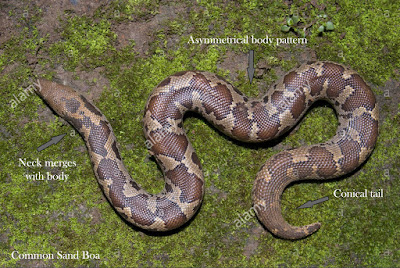
One other small snake is often mistaken for being Russell’s viper which is the Common Sand Boa(Gongylophis conicus). This snake is also called Russell’s boa. Sand boa has many physical similarities with Russell’s viper except its name. They both have a thick stout body. They both have a overall brown coloration with dark blotches. Both Russell’s viper and Russell’s boa have their head covered with many small keeled scales. Both these snakes have vertical pupil. But they have their differences too. Sand boa’s body tapers to both end very rapidly so its tail is almost conical in shape. Sand boa’s neck is so thick that it merges with body. Also the blotches on Sand Boa’s body is very asymmetrical and does not conform to any shape. Sand boa generally grows to about 0.5m-0.6m in length and rarely grows to about 1m.

One distinct feature which separate Russell’s viper from Sand Boa, Rock python or any other snake is its loud Hiss. It is so loud that almost compares to the sound of a ‘Pressure Cooker’. Once heard you will never forget it.


To learn more about them, follow these links.

Indian Rock Python

Common Sand Boa

Russell's Viper


To learn about the difference between Common Krait and Common Wolf Snake.

To learn about the difference between Indian Rat Snake and Cobra.


**images have been mostly collected from internet for the sole purpose of awareness and education. copyright of every image stays with their rightful owner. **

Thursday, January 16, 2014

New Year Gift ( Yellow Speckled Wolf Snake)

This day I got a call from a friend asking me if I would collect a snake they have captured or would they kill it. And I certainly told him to keep the snake for me. Then I asked him about the description of the snake and came to know that it is a green snake with spots on it. I was not sure which snake it was from the description but as it is not similar to any venomous snakes found here locally, I told him, “it is probably a non-venomous snake but still don’t touch it.”

This conversation happened in the morning and I was told to pick up the snake in the evening. The whole day I was thinking about the snake but could not decide what it could be and in the evening when I received the snake, reality exceeded all my expectations! It was a small snake, approximately 12”-14” long with brownish green back and white belly. Moreover it had two yellow spots on each scale. And I shouted in joy, “it’s a yellow-speckled wolf snake!!!!” whenever I saw its photo in books and various online groups, I wished to see one in real life but its distribution is so limited that I never thought I would see one ever, that too in my hometown. It was 2nd January and all I could think was that this was the best new year gift ever.

Yellow Speckled Wolf Snake ( Lycodon jara ) is a non-venomous snake found from West Bengal, Arunachal Pradesh and Ganjam district of Orissa in India and also from Nepal and Bangladesh. The maximum length recorded is 22”. It’s a smooth scaled, slender bodied snake. The head is slightly broader than the neck like all other wolf snakes. The upper side varies from glossy brown to purplish black. Belly side is white in color. Almost all the scales on its back have two yellow spots on them and thus the name. Sometime the spots are white in color. Very little is known about this snake. Only that it is a nocturnal snake and it eats geckos.
From my personal observation I found that this snake prefers corners and crevices than open place. Though it is a nocturnal snake, given a choice to stay between a dark open place and a bright corner, it feels more secure in the corner. It also hides its head slightly under its body coil like a few other wolf snakes. “And unlike the Common Wolf Snake, not tempermental and usually does not bite when handled.” Though the previous line was written for a few other wolf snakes like Barred Wolf Snake in the book ‘Snakes of India, The Field Guide’, I found it perfectly suitable for this one too.

When I released it in my own front yard, it was very quick to vanish from my eye and I am sure not to see it again ever though it is just in front of my house. Snakes have evolved to stay hidden so good that we often don’t realize how many snakes are there around us. That is infact in the benefit of both of us. Otherwise we would have killed all the snakes if we had the chance, or atleast that is the mentality of many of us. But it is good to know that people are changing. Thank you Utpal Das for this wonderful new year gift.

Saturday, November 16, 2013

Snake Dancing dilema

For the last few years, I was getting information about an age old tradition of snake dancing on a particular date of year but could not locate the place or date in specific. This year the situation was different. Few of my friends have already got the information and asked me if I am interested to go with them or not. I had no reason to reject them, so I hopped on their bike and off we go.


It was a very interior village and I am not disclosing the name because I don’t want to promote this practice. Anyway when we reached there, first we located the people who actually do the performance. By talking with them we came to know about many things. This snake dancing on the occasion of Lakhsmi Puja (a celebration of the goddess of wealth) is almost 150yrs old. All through the rainy season they catch the snakes in and around their village. And they only catch Monocellate Cobra and Spectacled Cobra because of their spectacular hood display. Then on this occasion, they perform the snake dancing for 3 consecutive days and release the snakes in the nearby river. (well, I was skeptical about how many snake will survive after the release.) Just before the ceremony, the organizers have emptied the venom glands of the snakes by making them bite repeatedly into papaya stalk. This way the dancers will not have to worry about the bites they may receive during the show.

At the scheduled time they transferred all the snakes to a small stage that was set in the fair ground. Each snake was in its own earthen pot. There were total 30-40 snakes of various size and age group but all are mostly adult only a few sub-adults. Then they started the show. There were 3-4 performers on the stage and a few other men to assist them. Performers were bringing out snakes one by one, played with them a little bit, then put it into its pot. It was a modest show. The music was deafening. A big crowd had gathered around the stage and they were very enthusiastic. Dancers were playing with 1-2 snakes at a time. Even I noticed to get bitten a few times but they didn’t care. This went on for approximately half an hour and came to an end.

One thing struck in my mind, most of the snakes were injured. They have injury on their head and several places on their body. If this is the type of performance that I saw was going on, then they don’t have any chance of having that extent of injuries. When I expressed my concern to my friends, they showed me the pictures from the first day of the event. This took me by surprise.

People are holding 5-8 snakes together over their head. Snakes are biting each other ferociously; they are biting the performers also. Blood was seen everywhere. The performers were even seen rolling on the stage over the snakes, which is severely dangerous for the snakes. I was wondering how this could go on un-noticed by the forest dept. Then from a member of the organizers I came to know that forest dept had stopped the program for 3 years in the past. But like all other activity in our country, they had made some arrangement with the local forest dept. So I guess this will go on for another few years in the future.

Sunday, November 27, 2011

Deadly affair (common indian krait)

On this evening, I was browsing internet in my room, suddenly I heard some people talking about some snake. It seemed like somebody have spotted some snake. So I grabbed a light and rushed to the spot. 3-4 people have gathered in front of the house beside our house. They told me that someone saw a black snake when she was entering the house and came out of the house. I thought it would be common wolf snake as always. I entered the house. It had a small varandah at the entrance and then there is the gate is the gate of the bedroom. One side of the varandah was filled with coconut, what an ideal place for a snake, and the other side had some bricks stored. After a while, fortunately i found the snake in the brick stack.


I was surprised. I never imagined it to be a krait and there it was a common Indian krait waiting behind the bricks. This is my first krait sighting. I quickly told the people to get a strong stick and get some more light. I secured the head with stick and was about to catch the snake, suddenly a over-enthusiast man showed up with a big log in his hand. He didn’t hear anybody and straight tried to kill the snake. I was in an awkward situation. With one hand I was holding the stick with which I had secured the head of the snake and with the other hand I was trying to cover the blows made with the big log. The most terrifying thing was that the snake is no ordinary snake, it is the most venomous snake of asia. After a few blows the man paused for a second and I quickly captured the snake and started walking straight to my house. I put it in a plastic jar and kept it in a secure place.


Common Indian krait or Bungarus caeruleus is a nocturnal snake. In the daytime it is a very lazy and timid snake but at night a sharp contrast in behaviour can be seen. It becomes very active, alert and dangerous. In the daytime it generally rests in termite mounds, rodent burrows, stacks of bricks, rubbles or even inside household items like rolled up carpets. This snake is so well adopted in various habitats that it is found in almost all of India except Kashmir and Arunachal Pradesh. It is mainly found in fields, low scrub jungles and even in marshy lands. It is also found near human habitation and often enters inside houses. This particular behaviour makes it more dangerous. Some time people get bitten unknowingly when they are asleep. Their bite is not as painful as cobra or viper bite but it is far more virulent than the two (it is 15 times more potent than the cobra). Its venom is both neurotoxic and heamotoxic. It is the MOST VENEMOUS snake of India. Bite from this snake must be treated at hospital with antivenom serum. Otherwise death will come in 5 to 12 hours. Symptoms are like cobra bite, drooping eyelid, severe abdominal pain, vomiting and respiratory problem. Usually the cause of death is respiratory failure.

It is a cannibalistic snake. It usually eats other snake often of the same species. It also eats frogs, lizards and mouse. It attains a maximum length of 1.73 m but average size is 1.2m. the specimen i caught was around 1m in length. May be due to their cannibalistic nature at the time of mating, they first carry out an examination of each other and then settles down together. Mating occurs in February- march. Kraits also stay with the eggs like the cobras.

After a few days I planned to release the Krait. But finding a suitable place was a real headache. There was no suitable place remote enough to release the snake. I had to travel 30km to find a place for the releasing. every day more and more lands are being converted into farmland, commercial land or residential area. Snakes and other life forms are finding it hard to find an unused patch of land which they can use as their safe refuse.

**One interesting fact I would like to mention. On my journey of 60 km, I found atleast 14 dead snakes, all are road kill, run over by cars. 6 of the snakes are olive keelback water snake, 4 are chekered keelback water snake, 2 are buff stripped keelback land snake, 1 is a rat snake and the other one was not in identifiable condition.

Monday, July 19, 2010

Russells Viper Rescued

Extraordinary feats can be achieved in two ways, either you’re real brave or real dumb. And I have witnessed something like that..

Previous Sunday, a friend told me,” hey! Didn’t you hear? Somebody had caught a juvenile rock python in a medical store.” And that happens to be near the place where I generally hang out with friends. So I rushed to the place to check out the buzz. But what I saw was unbelievable. A little Russells Viper was hissing inside a plastic jar!!!

The jar was ventilated at the top portion by some small holes. So I figured out that they somehow captured it, put it inside the jar and made the holes for air circulation. That was a relief seeing people becoming aware about conservation. Because what I have witnessed till now is that people kill snake at the first opportunity. But what was more amusing was the expression on the face of the man when I told him that it was no Rock Python, rather it’s a extremely venomous Russells Viper. He was stunned. He said in disbelief, “how the hell did I capture it??”

It was a very beautiful, lively and healthy snake. I was too willing to have it for relocation. ‘cause that way I will be able to take some snaps of it at the time of releasing. But they said they had already called the Forest Dept. and the dept instructed them to hold the snake for the day as it was Sunday. They will come on Monday and take custody of the snake. The people from the medical store were okey with it. So I decided not to interfere with the workings of Forest Dept. but at the time of leaving I told them that if they for any reason don’t want to keep the snake anymore, I will be more than happy to help them deliver the snake to the Forest dept as I have contacts in there.

After that day, I completely forgot about the incident. On Friday evening, one of my friends who were related with the medical store asked me to take the snake. I was surprised ,” haven’t the officials taken the snake?” He said that not even a single phone call from them in the whole week. So in the next morning I bought the snake home and the next day released it in a suitable place.


Now what was most unnerving about the whole thing was the role of the Forest Dept. They are supposed to be there for the protection of wildlife and increasing awareness among people and here a snake is confined inside a small jar for a long week without food and water and fellow people are living uneasily around it. From this experience, the man who bothered to capture the snake alive and call the Forest Dept. would ever do the same again?? ‘cause now he knows the Dept. wouldn’t come and it will only increase his trouble. Instead of he will just kill and get rid of the snake. No law can protect wildlife if the people who are affected are made aware. Only because these kind of people who take extra pain-in-their-ass to save a life(wild) are there, the whole wildlife is not extinct altogether yet. So, three cheers for the one who saved a snake.

Natural history

Russells Viper is one of the most common snakes of India. Yet it is extra-ordinary in many ways. Russells Viper has got the largest fangs of all India vipers. The average size is about 16mm. Moreover it has two fangs on each side. The venom is haemotoxic i.e. it destroys blood and blood vessels. The common symptoms of biting are burning sensation and swelling at the bite site, extensive internal haemorrhage, pain, vomiting, bleeding from body orifices. Pressure drops significantly and pulse becomes weak. Though it is one of the four snakes responsible for most snake bite deaths in India, Russells Viper does not strike readily. It is generally sluggish and being heavily bodied viper, it is not reluctant to leave. So it inflates its body and hisses and when I say hisses, I mean hisses like a ‘pressure cooker’. It is so loud that if someone heard it he will never forget. Then the viper coils its body in a ‘S’ curve and sways its head side by side. And at last if all this warning and threat display falls in deaf ears, it strikes. And it strikes like a spring, faster than expected from a heavily bodied viper like this. It is usually nocturnal i.e. it hunts at night. So chances of bite are less. People often get bitten when they step on it at night. In daytime thorny bushes are its favorite resting place, so be careful. Although Russells Viper is venomous, it is not actually bad to protect them. The primary preys of it are rodents. Considering the damage rodents do to our crop production, it is actually doing a social work.

And a last word. May be Russells Viper is extremely venomous but timely and proper medical care can cure the victim properly. The death toll is high only because most of the people don’t seek proper medical attention in time from the lack of awareness.