Day by day Russell”s Viper(Daboia russelli) is becoming the most medically important snake for Eastern India. So it is very essential to identify this snake properly and do not confuse it with other similar snake like Indian Rock Python(Python molurus), which is a non-venomous snake.
To understand why it is becoming so important, we need to understand how we fight snakebite in our country. The only treatment is Polyvalent Antivenom Serum (ASV), which is administered to the victim in case of venomous snakebite. This ASV is made from the venom of Cobra(Naja naja), Russell’s viper, Common Krait(Bungarus caeruleus) and Saw scaled viper(Echis carinatus). Most of the ASV production centers are situated in South India and all the snakes they use for ASV venom collection are collected from South India. Now-a-days this ASV is proving to be less effective in combating Russell’s Viper bite in Eastern India. The geographical variation has changed the chemical composition of Russell’s Viper’s venom from South India to North India. The studies of snakebite and its treatment clearly indicates this. In Eastern India it is becoming harder and harder to treat a Russell’s Viper bite victim. So doctors and experts are requesting to setup a venom collection center in Eastern India so we can eliminate geographical variation but till now Govt has not reacted positively.
Anyway, the best way is not to get bitten in the first place. For that you need to identify it properly. People often confuse Russell’s viper with Rock python as both have stocky muscular body and generally brown coloration with dark spots. But following these simple points you can be sure which one is which. But venomous or non-venomous, you should not try to handle any of these snakes. It is always better to give them their space and let them escape. Or call the local forest dept.

Russell’s viper generally grows to about 1m in length, whereas the Rock python in average grows to about 3m in length. So if you guess the length to be around 2m or more, you can be sure it to be a Rock python. But do not totally depend on this as snakes when coiled can look much longer or shorter than they actually are.
From a distance we can see the body pattern. Russell’s Viper has well defined round or oval shaped patterns along its back which are a bit pointed at two ends. They also have half or full oval blotches along their side. Now depending on the location of the specimen, these blotches can be dark edged with light center (North India) or solid dark (South India). The patterns on Rock python are asymmetrical and in general quadrate in shape. They are mostly solid dark sometimes with light center.

Inspection of the head and neck revels many more differences. In Russell’s viper the head is triangular in shape. The head of Rock python is elongated. Typical of all the vipers, Russell’s viper’s neck is also very distinct from its body where as Rock python’s neck is not so distinct. Russell’s viper’s head is covered with many small keeled scales. Rock python’s head is covered with few big smooth scales. Python also has 3 slits on its upper lips frontal side on both side which are its temperature sensory organ. This feature is not so easily visible. Russell’s viper does not have this. Both the snake have vertical pupil.
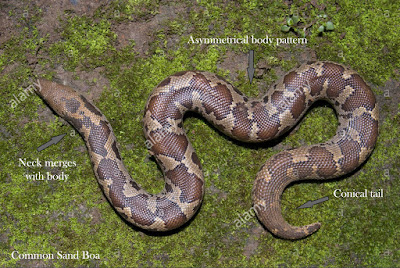
One other small snake is often mistaken for being Russell’s viper which is the Common Sand Boa(Gongylophis conicus). This snake is also called Russell’s boa. Sand boa has many physical similarities with Russell’s viper except its name. They both have a thick stout body. They both have a overall brown coloration with dark blotches. Both Russell’s viper and Russell’s boa have their head covered with many small keeled scales. Both these snakes have vertical pupil. But they have their differences too. Sand boa’s body tapers to both end very rapidly so its tail is almost conical in shape. Sand boa’s neck is so thick that it merges with body. Also the blotches on Sand Boa’s body is very asymmetrical and does not conform to any shape. Sand boa generally grows to about 0.5m-0.6m in length and rarely grows to about 1m.
One distinct feature which separate Russell’s viper from Sand Boa, Rock python or any other snake is its loud Hiss. It is so loud that almost compares to the sound of a ‘Pressure Cooker’. Once heard you will never forget it.
To learn more about them, follow these links.
Indian Rock Python
Common Sand Boa
Russell's Viper
To learn about the difference between Common Krait and Common Wolf Snake.
To learn about the difference between Indian Rat Snake and Cobra.
**images have been mostly collected from internet for the sole purpose of awareness and education. copyright of every image stays with their rightful owner. **
To understand why it is becoming so important, we need to understand how we fight snakebite in our country. The only treatment is Polyvalent Antivenom Serum (ASV), which is administered to the victim in case of venomous snakebite. This ASV is made from the venom of Cobra(Naja naja), Russell’s viper, Common Krait(Bungarus caeruleus) and Saw scaled viper(Echis carinatus). Most of the ASV production centers are situated in South India and all the snakes they use for ASV venom collection are collected from South India. Now-a-days this ASV is proving to be less effective in combating Russell’s Viper bite in Eastern India. The geographical variation has changed the chemical composition of Russell’s Viper’s venom from South India to North India. The studies of snakebite and its treatment clearly indicates this. In Eastern India it is becoming harder and harder to treat a Russell’s Viper bite victim. So doctors and experts are requesting to setup a venom collection center in Eastern India so we can eliminate geographical variation but till now Govt has not reacted positively.
Anyway, the best way is not to get bitten in the first place. For that you need to identify it properly. People often confuse Russell’s viper with Rock python as both have stocky muscular body and generally brown coloration with dark spots. But following these simple points you can be sure which one is which. But venomous or non-venomous, you should not try to handle any of these snakes. It is always better to give them their space and let them escape. Or call the local forest dept.

From a distance we can see the body pattern. Russell’s Viper has well defined round or oval shaped patterns along its back which are a bit pointed at two ends. They also have half or full oval blotches along their side. Now depending on the location of the specimen, these blotches can be dark edged with light center (North India) or solid dark (South India). The patterns on Rock python are asymmetrical and in general quadrate in shape. They are mostly solid dark sometimes with light center.

Inspection of the head and neck revels many more differences. In Russell’s viper the head is triangular in shape. The head of Rock python is elongated. Typical of all the vipers, Russell’s viper’s neck is also very distinct from its body where as Rock python’s neck is not so distinct. Russell’s viper’s head is covered with many small keeled scales. Rock python’s head is covered with few big smooth scales. Python also has 3 slits on its upper lips frontal side on both side which are its temperature sensory organ. This feature is not so easily visible. Russell’s viper does not have this. Both the snake have vertical pupil.

One other small snake is often mistaken for being Russell’s viper which is the Common Sand Boa(Gongylophis conicus). This snake is also called Russell’s boa. Sand boa has many physical similarities with Russell’s viper except its name. They both have a thick stout body. They both have a overall brown coloration with dark blotches. Both Russell’s viper and Russell’s boa have their head covered with many small keeled scales. Both these snakes have vertical pupil. But they have their differences too. Sand boa’s body tapers to both end very rapidly so its tail is almost conical in shape. Sand boa’s neck is so thick that it merges with body. Also the blotches on Sand Boa’s body is very asymmetrical and does not conform to any shape. Sand boa generally grows to about 0.5m-0.6m in length and rarely grows to about 1m.
One distinct feature which separate Russell’s viper from Sand Boa, Rock python or any other snake is its loud Hiss. It is so loud that almost compares to the sound of a ‘Pressure Cooker’. Once heard you will never forget it.
To learn more about them, follow these links.
Indian Rock Python
Common Sand Boa
Russell's Viper
To learn about the difference between Common Krait and Common Wolf Snake.
To learn about the difference between Indian Rat Snake and Cobra.
**images have been mostly collected from internet for the sole purpose of awareness and education. copyright of every image stays with their rightful owner. **


