Showing posts with label frog. Show all posts

Sunday, June 14, 2020

Cyclone Cheerleaders, Narrow Mouthed Frog

A few days back cyclone Amphan has hit our area very hard. It was the biggest cyclone that has hit our area may be in last 100 years. As the cyclone was blowing over our area, we all were hanging onto our dear life. I think all the birds, animals who were not under water or inside a burrow were frightened. But there was a group of animals who were actually cheering up. They were singing in happiness. There voices were reaching our ears over the sound of the severe storm.


Common Indian Toad
We have three lily ponds in our front yard. And as the saying goes, ‘where there is water, there is frog’, atleast when it rains. So these three tiny water bodies become the go to place for the nearby frogs and toads in the mating season. They all gather there and start their chorus song, each one in their own pitch and tempo. These are the only ones who became happy in the time of cyclone.

Bull Frog Sp.
So in the night when the cyclone had passed over our area and the storm had decreased in intensity, I decided to catch the culprits red handed. So armed with a torch and my camera, I stepped in our front yard. Due to my sudden appearance they stopped for a moment. Then started calling again one by one. I found that the whole area is teeming with frogs and toads. I had to be careful before putting my steps anywhere.

Jerdon's Bull Frog
There was mostly Common Indian Toad (Duttaphrynus melanostictus) of various sizes. Then there was a cricket frog (Fejerverya limnocharis). Another most common frog was bull frogs. They may be Jerdon’s Bull frog (Hoplobatrachus crassus) or may be Indian Bull Frog (Hoplobatrachus tigerinus). As both are found in our area identifying small ones is a bit problem. There was a huge Indian Bull Frog also measuring snout to vent around 6” in length. But there was someone whose calls were loudest of all yet it could not be seen any where. Only as I crouched on my knees that I found a tiny little frog calling from under dry leaves. It was a Ornate Narrow Mouthed Frog (Microhyla ornata).
Indian Bull Frog
They are really tiny, about the size of fingernail. They rarely reach lengths more than 25mm. True to their name, there mouth is small compared to other frogs. They are generally found all over India, South East Asia, South China and Taiwan. It is one of the smallest amphibian of India too. Ornate Narrow Mouth frogs eat ants and other small insects. Breading starts with the onset of monsoon
. Several males may gather at a place and start calling the ladies. But as they as surprisingly loud and have a ventriloquilistic quality, finding the frog in leaf litter or in grass become very difficult. They are a good jumper too. They can jump almost a feet or more which is huge compared to their own body length.

Ornate Narrow Mouthed Frog
Our home is surrounded by such little jewels which are there to discovered. It only takes a little initiative to actually go there and find them.

Ornate Narrow Mouthed Frog


***Side note: if bull frogs are so common, so why dont we see big bull frogs often?? Read this blog to know about that.

Friday, May 24, 2019

Love is in the water

I have always thought of photographing frogs at night but didn’t do it. Mainly due to my enormous laziness. But a few days back when I returned from work I heard the frogs were calling their hearts out. We have pumped out the water of our pond and there many frogs gathered. So I thought this is the day. I changed dress took out my camera and went looking for frogs.

 Armed with a mini flashlight when I entered the area suddenly all frogs stopped calling. Only after a few silent and dark minutes they started to call one by one. Except a few species only the male frogs call. The females choose the males based on their call. By analysing the call, females can identify species, size, health etc of the male frog. Frog call also has many different purpose. They announce there presence with it, they impress the females for mating with it, they also deter rivals with call. But this call also attracts predators. So they have to be alert too. Calling is also physically very demanding for them.


So following the call I mainly found indian cricket frogs there. Two big sized bull frog were also there. Then I found a checkered keelback water snake waiting patiently at the edge of water for a tasty frog dinner. At the same time, from the other side of the pond I heard the distinct sound of a dying frog captured by a snake. When these non venomous snakes, checkered keelback, rat snake etc catch a frog, they dont kill the frog, instead directly swallow the frog. At this time frogs make a typical sound, once heard you will never mistake it to identify. But where are the couples?? 

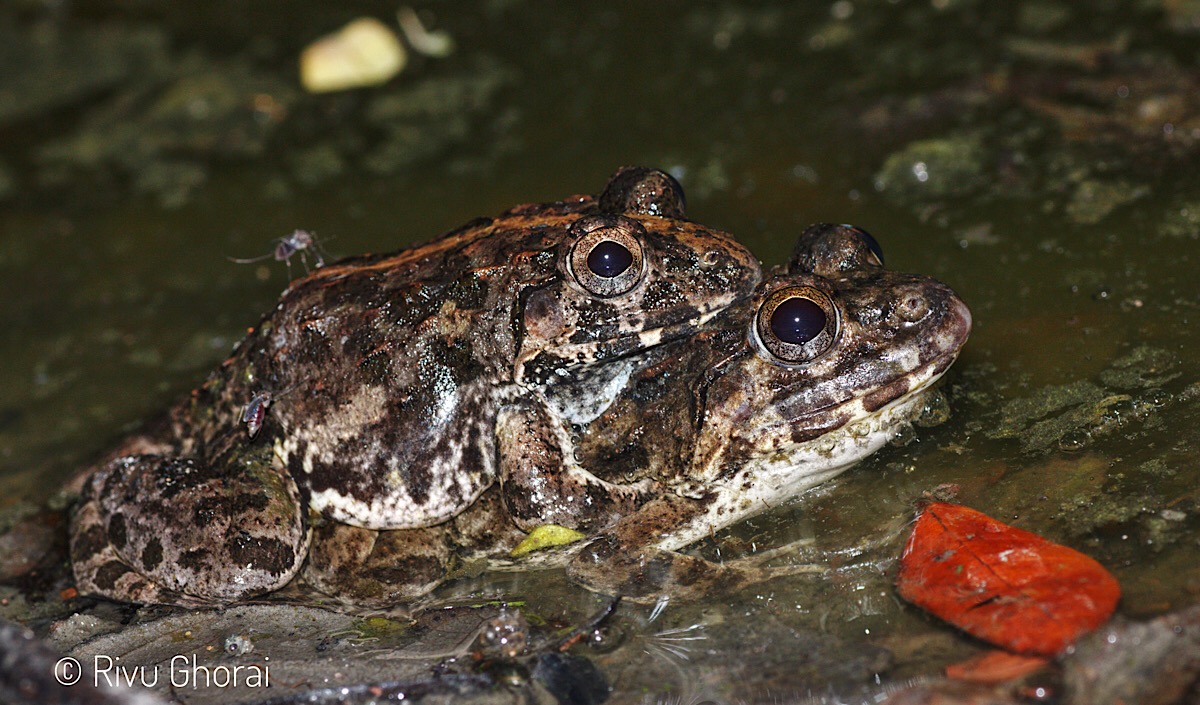
This was not a rainy day. So there was no mating frenzy. After searching for some time I found a couple of cricket frog. They were in amplexus. This is a typical pose found in many external fertilisation species but mainly in amphibians. The male climbs up the back of the female and grasp her in the throat, armpit or belly region with their forearm. This way when the female frog releases egg, the male can simultaneously release sperm to facilitate the external fertilisation of their eggs. Frogs show many different type of parental behaviour. Frogs like our cricket frog, pond frog, indian toad etc who show no parental work, they rely on enormous number of eggs. On the other extreme poison dart frog of amazon rainforest lays only a few eggs. Then after hatching they carry the tadpoles on their back and deposit them on their individual pool singly. The female frog supply the tadpoles with unfertilised egg as food until they transform as a frog. There are many other type of example in between. 

After spotting this couple, I couldn’t find any other. Waited for ling, donated atleast a litre blood to mosquitoes but still no success. So I called it a day. This was a good experience. I had to try it in other places also to find other frog species in amplexus. 

Friday, July 6, 2012

Jumping Chicken (Frog Meat Trade)


A few days back when I was browsing Facebook, I stumbled upon an interesting cartoon. It was about frog meat industry. I got interested and tried to find out more. A little bit of searching and reading brought out some anxious facts.
image courtesy: http://www.savethefrogs.com
In contrary to my belief that only tribal and rural people eats frogs, it is a delicacy among the people of 1st world countries. Even they have depleted their frog population so much that they are forced to import it from third world countries of Latin America and South-east Asia. Currently Indonesia is the biggest exporter of frog legs. It exports about 142 million frogs each year and about 7times of this number is consumed in the country. Thailand, China, Malaysia, Brazil and several other countries also exports frog legs. Frog legs are popular in south east Asian countries but they are in huge demand in countries like France, Italy, USA etc. even Mr. Barak Obama was seen eating frog legs in a party. This demand has resulted in the disappearance of many frog species and several other species have become rare. A few countries have set up frog farms to supply the demand but still most of the frogs come from the wild.
image courtesy: Getty images
What is the actual impact of this? A few years back India was the biggest exporter of frog legs. This trade was so popular that frogs were called jumping chicken. But India has banned this trade in 1987. Bangladesh has also banned it in 1990. They must have good reasons to so. This frog meat trade does not affect all frog species. It only targets the bigger species. In India, the targeted species were Indian Pond Frog(Euphlyctis cyanophlyctis), Indian Bull Frog(Hoplobatrachus tigerinus), Jerdon’s Bull Frog(Hoplobatrachus crassus). Frogs are a natural insecticide. They eat a whole lot of insects, molluscs and other things that damages our crop production. And the bigger the frog, the more insect it can eat. Not only in frog stage, in the tadpole stage also it helps us by cleaning up the water. Now when we picked up frogs from the environment, the insect population multiplied considerably and crop damage also have increased. The problem became so severe in India that the revenue lost due to crop damage far exceeded the revenue generated through frog leg exporting. Same thing has happened with Bangladesh and same thing will happen with the other countries too. Frogs are an important part of our eco-system and removing them from it is not a wise decision.
Indian Bull Frog
15yrs after banning the trade, frog population in India has revived itself and the species are not in danger anymore. But thanks to Mr. Manjunath Sullolli an image from Goa brings out the question again, “has the trade really stopped in India?” Actually as long as there will be demand in the market, some people will always be ready to supply. If only we can change our taste for frog meat, the frogs can really be saved.
image courtesy: Mr. Manjunath Sullolli