A few days back cyclone Amphan has hit our area very hard. It was the biggest cyclone that has hit our area may be in last 100 years. As the cyclone was blowing over our area, we all were hanging onto our dear life. I think all the birds, animals who were not under water or inside a burrow were frightened. But there was a group of animals who were actually cheering up. They were singing in happiness. There voices were reaching our ears over the sound of the severe storm.
 |
| Common Indian Toad |
We have three lily ponds in our front yard. And as the saying goes, ‘where there is water, there is frog’, atleast when it rains. So these three tiny water bodies become the go to place for the nearby frogs and toads in the mating season. They all gather there and start their chorus song, each one in their own pitch and tempo. These are the only ones who became happy in the time of cyclone.
 |
| Bull Frog Sp. |
So in the night when the cyclone had passed over our area and the storm had decreased in intensity, I decided to catch the culprits red handed. So armed with a torch and my camera, I stepped in our front yard. Due to my sudden appearance they stopped for a moment. Then started calling again one by one. I found that the whole area is teeming with frogs and toads. I had to be careful before putting my steps anywhere.
 |
| Jerdon's Bull Frog |
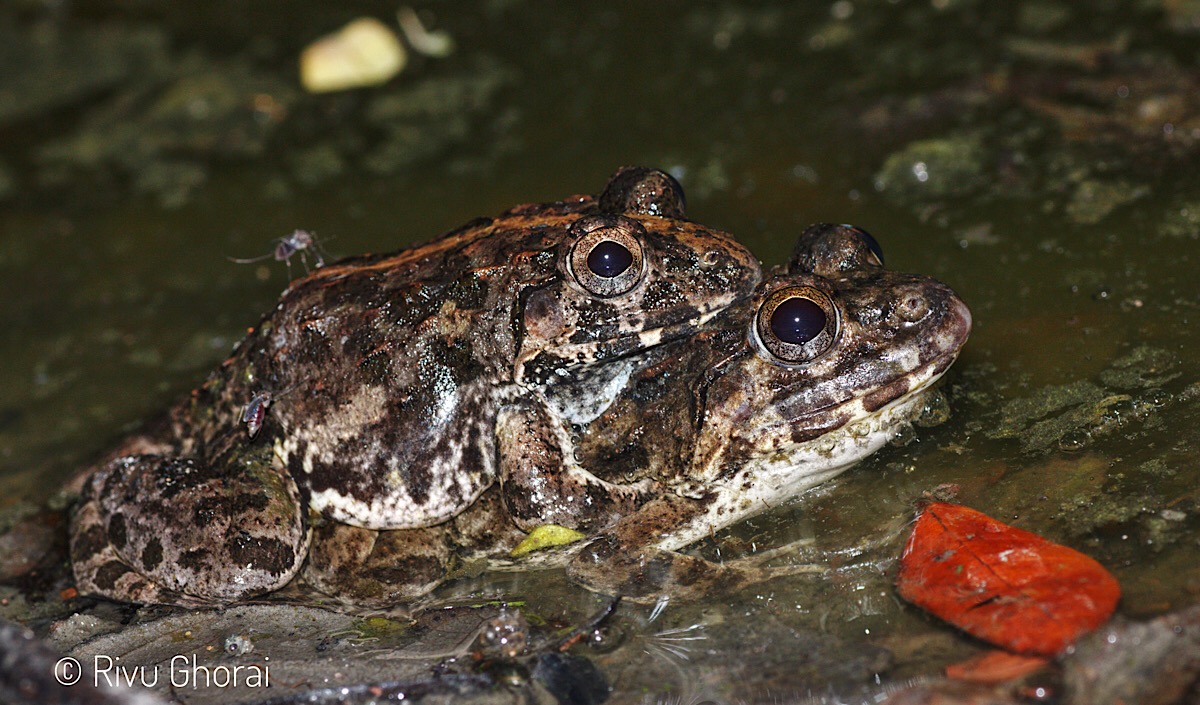
There was mostly Common Indian Toad (Duttaphrynus melanostictus) of various sizes. Then there was a cricket frog (Fejerverya limnocharis). Another most common frog was bull frogs. They may be Jerdon’s Bull frog (Hoplobatrachus crassus) or may be Indian Bull Frog (Hoplobatrachus tigerinus). As both are found in our area identifying small ones is a bit problem. There was a huge Indian Bull Frog also measuring snout to vent around 6” in length. But there was someone whose calls were loudest of all yet it could not be seen any where. Only as I crouched on my knees that I found a tiny little frog calling from under dry leaves. It was a Ornate Narrow Mouthed Frog (Microhyla ornata).
 |
| Indian Bull Frog |
They are really tiny, about the size of fingernail. They rarely reach lengths more than 25mm. True to their name, there mouth is small compared to other frogs. They are generally found all over India, South East Asia, South China and Taiwan. It is one of the smallest amphibian of India too. Ornate Narrow Mouth frogs eat ants and other small insects. Breading starts with the onset of monsoon
. Several males may gather at a place and start calling the ladies. But as they as surprisingly loud and have a ventriloquilistic quality, finding the frog in leaf litter or in grass become very difficult. They are a good jumper too. They can jump almost a feet or more which is huge compared to their own body length.
 |
| Ornate Narrow Mouthed Frog |
Our home is surrounded by such little jewels which are there to discovered. It only takes a little initiative to actually go there and find them.
 |
| Ornate Narrow Mouthed Frog |
***Side note: if bull frogs are so common, so why dont we see big bull frogs often??
Read this blog to know about that.