Tuesday, February 4, 2020

How to differentiate between Russell's Viper and Rock Python

Day by day Russell”s Viper(Daboia russelli) is becoming the most medically important snake for Eastern India. So it is very essential to identify this snake properly and do not confuse it with other similar snake like Indian Rock Python(Python molurus), which is a non-venomous snake.

To understand why it is becoming so important, we need to understand how we fight snakebite in our country. The only treatment is Polyvalent Antivenom Serum (ASV), which is administered to the victim in case of venomous snakebite. This ASV is made from the venom of Cobra(Naja naja), Russell’s viper, Common Krait(Bungarus caeruleus) and Saw scaled viper(Echis carinatus). Most of the ASV production centers are situated in South India and all the snakes they use for ASV venom collection are collected from South India. Now-a-days this ASV is proving to be less effective in combating Russell’s Viper bite in Eastern India. The geographical variation has changed the chemical composition of Russell’s Viper’s venom from South India to North India. The studies of snakebite and its treatment clearly indicates this. In Eastern India it is becoming harder and harder to treat a Russell’s Viper bite victim. So doctors and experts are requesting to setup a venom collection center in Eastern India so we can eliminate geographical variation but till now Govt has not reacted positively.

Anyway, the best way is not to get bitten in the first place. For that you need to identify it properly. People often confuse Russell’s viper with Rock python as both have stocky muscular body and generally brown coloration with dark spots. But following these simple points you can be sure which one is which. But venomous or non-venomous, you should not try to handle any of these snakes. It is always better to give them their space and let them escape. Or call the local forest dept.


Russell’s viper generally grows to about 1m in length, whereas the Rock python in average grows to about 3m in length. So if you guess the length to be around 2m or more, you can be sure it to be a Rock python. But do not totally depend on this as snakes when coiled can look much longer or shorter than they actually are.

From a distance we can see the body pattern. Russell’s Viper has well defined round or oval shaped patterns along its back which are a bit pointed at two ends. They also have half or full oval blotches along their side. Now depending on the location of the specimen, these blotches can be dark edged with light center (North India) or solid dark (South India). The patterns on Rock python are asymmetrical and in general quadrate in shape. They are mostly solid dark sometimes with light center.

Inspection of the head and neck revels many more differences. In Russell’s viper the head is triangular in shape. The head of Rock python is elongated. Typical of all the vipers, Russell’s viper’s neck is also very distinct from its body where as Rock python’s neck is not so distinct. Russell’s viper’s head is covered with many small keeled scales. Rock python’s head is covered with few big smooth scales. Python also has 3 slits on its upper lips frontal side on both side which are its temperature sensory organ. This feature is not so easily visible. Russell’s viper does not have this. Both the snake have vertical pupil.
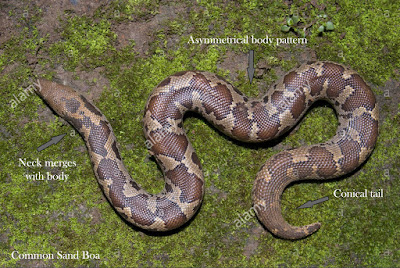
One other small snake is often mistaken for being Russell’s viper which is the Common Sand Boa(Gongylophis conicus). This snake is also called Russell’s boa. Sand boa has many physical similarities with Russell’s viper except its name. They both have a thick stout body. They both have a overall brown coloration with dark blotches. Both Russell’s viper and Russell’s boa have their head covered with many small keeled scales. Both these snakes have vertical pupil. But they have their differences too. Sand boa’s body tapers to both end very rapidly so its tail is almost conical in shape. Sand boa’s neck is so thick that it merges with body. Also the blotches on Sand Boa’s body is very asymmetrical and does not conform to any shape. Sand boa generally grows to about 0.5m-0.6m in length and rarely grows to about 1m.

One distinct feature which separate Russell’s viper from Sand Boa, Rock python or any other snake is its loud Hiss. It is so loud that almost compares to the sound of a ‘Pressure Cooker’. Once heard you will never forget it.


To learn more about them, follow these links.

Indian Rock Python

Common Sand Boa

Russell's Viper


To learn about the difference between Common Krait and Common Wolf Snake.

To learn about the difference between Indian Rat Snake and Cobra.


**images have been mostly collected from internet for the sole purpose of awareness and education. copyright of every image stays with their rightful owner. **

Tuesday, January 21, 2020

How to differentiate between Rat snake vs Indian Cobra

A few days back while on duty I was chatting with a senior colleague and found out about his interest in snakes. So I showed him my blog. As he was browsing through my posts, he told me a story of how he once escaped a cobra bite just by chance. Then he asked me about how a common man can differentiate between a Cobra (Naja naja, Naja kaouthia) and a Rat Snake (Ptyas mucosa).

That question hit my head too. As I searched the internet for some ready article to differentiate between them, I could not find any. So I tried to compile points I found in various places into a single article so that anyone can refer to it and stay safe.

A word of CAUTION. Even if you know the snake infront of you is a non-venomous rat snake, not a venomous cobra, DO NOT TRY TO HANDLE IT! That is harmful for both the snake and yourself. Give it some space to escape and it will escape eventually.


If I explain from the easiest sign to hardest, the first and most intimidating sign would be the hood. Cobras (when I mention cobra, I am referring to both Monocled Cobra and Spectacled Cobra) raise hood when threatened. Monocled cobra has a ‘eye’ like design on the back of its hood whereas Spectacled Cobra has a ‘U’ shaped marking or it may have no marking on the back of its hood. To display its hood, a cobra raises its forebody from the ground and flares its neck. Now the Rat Snake also mimics this behavior just to pretend to be a cobra. The rat snake also lifts its forebody and tries to flare it neck. But its neck does not create a hood.


But what if a cobra does not raise a hood? May be it didn’t see you or may be it didn’t see you as a threat, then how can you tell. In that case we have to see the head carefully. On the Rat Snake, along its lips below the eye, there are prominent black vertical stripes. The cobra lacks this vertical black stripes.


Do not try to differentiate them by the color of their body. Both the Rat Snake and Cobras vary highly in body coloration. Their color can be from very light to very dark. Monocled Cobra juveniles have mostly dark colors with light banding across the body. The color fades to olive as they mature, the banding fades too. You can usually find black makings on the rear portion of an adult Rat Snake. Also, rat snake has black markings on it belly side.


But if they vary so much, how the experts tell them apart? They count the scales on their body, on their head and on their tail. That is the only sure way to tell two species of snake apart. But that process is not for the common man as that requires you to handle the snake. But if you are still interested to know about the scalation, follow these links to find out more.


To learn about the difference between Common Krait and Wolf Snake.

To learn about the difference between Russell's Viper and Sand Boa.


**images have been mostly collected from internet for the sole purpose of awareness and education. copyright of every image stays with their rightful owner. **

Friday, May 24, 2019

Love is in the water

I have always thought of photographing frogs at night but didn’t do it. Mainly due to my enormous laziness. But a few days back when I returned from work I heard the frogs were calling their hearts out. We have pumped out the water of our pond and there many frogs gathered. So I thought this is the day. I changed dress took out my camera and went looking for frogs.

 Armed with a mini flashlight when I entered the area suddenly all frogs stopped calling. Only after a few silent and dark minutes they started to call one by one. Except a few species only the male frogs call. The females choose the males based on their call. By analysing the call, females can identify species, size, health etc of the male frog. Frog call also has many different purpose. They announce there presence with it, they impress the females for mating with it, they also deter rivals with call. But this call also attracts predators. So they have to be alert too. Calling is also physically very demanding for them.


So following the call I mainly found indian cricket frogs there. Two big sized bull frog were also there. Then I found a checkered keelback water snake waiting patiently at the edge of water for a tasty frog dinner. At the same time, from the other side of the pond I heard the distinct sound of a dying frog captured by a snake. When these non venomous snakes, checkered keelback, rat snake etc catch a frog, they dont kill the frog, instead directly swallow the frog. At this time frogs make a typical sound, once heard you will never mistake it to identify. But where are the couples?? 

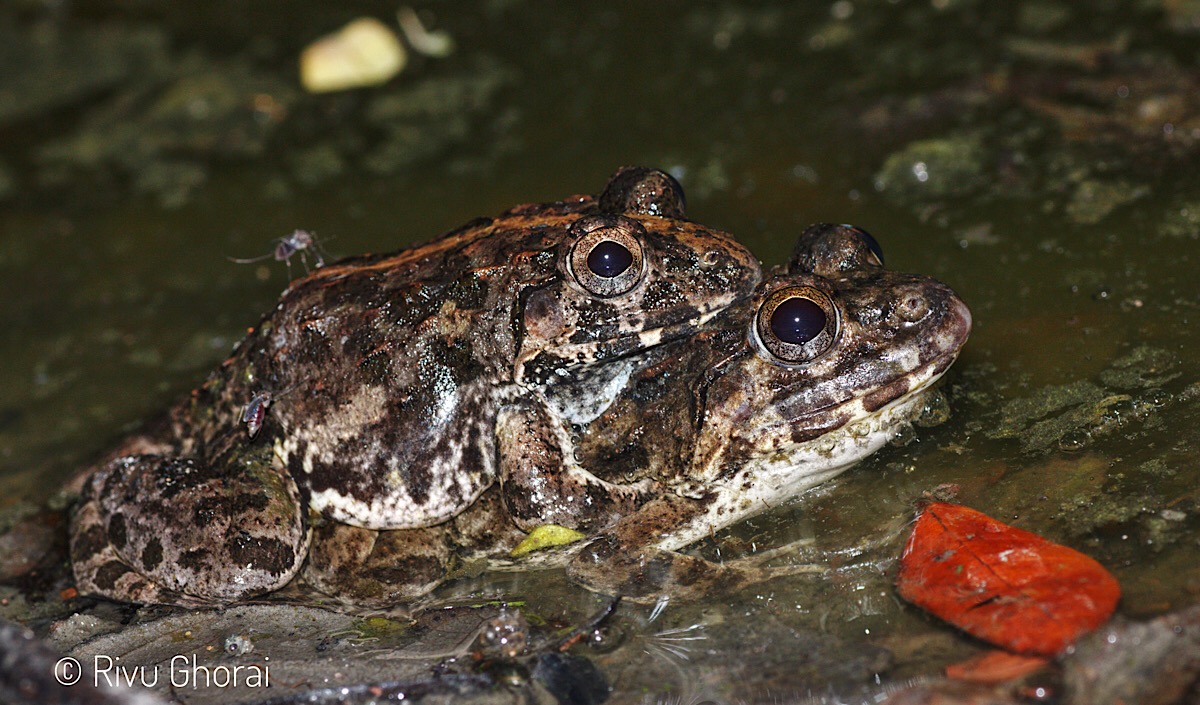
This was not a rainy day. So there was no mating frenzy. After searching for some time I found a couple of cricket frog. They were in amplexus. This is a typical pose found in many external fertilisation species but mainly in amphibians. The male climbs up the back of the female and grasp her in the throat, armpit or belly region with their forearm. This way when the female frog releases egg, the male can simultaneously release sperm to facilitate the external fertilisation of their eggs. Frogs show many different type of parental behaviour. Frogs like our cricket frog, pond frog, indian toad etc who show no parental work, they rely on enormous number of eggs. On the other extreme poison dart frog of amazon rainforest lays only a few eggs. Then after hatching they carry the tadpoles on their back and deposit them on their individual pool singly. The female frog supply the tadpoles with unfertilised egg as food until they transform as a frog. There are many other type of example in between. 

After spotting this couple, I couldn’t find any other. Waited for ling, donated atleast a litre blood to mosquitoes but still no success. So I called it a day. This was a good experience. I had to try it in other places also to find other frog species in amplexus. 

Monday, March 16, 2015

Killing Tides

India represents 5 species of sea turtles i.e. Olive Ridley, Green Turtle, Hawksbill Turtle, Loggerhead Turtle and Latherback Turtle. Of these, except the Latherback, other four are reported from the coast of West Bengal. The sea turtle habitat of West Bengal is represented by a 50km coastline of Purba Medinipur district and the sea facing islands of Sundarban Biosphere Reserve. The coast line of Purba Medinipur is a densely populated area with no forest cover except the casurina plantation in a few areas. So the area is not suitable for sea turtle nesting. Thus only a few individual nests were recorded over the years. The sea facing islands of Sundarban are devoid of any human habitation, and has good forest cover with sandy beaches. They are protected areas also. So, these islands harbor a few hundred nests each year. Only Olive Ridley nests were reported from West Bengal. Thus we can see that the whole coastal zone of West Bengal don’t have much nesting activity. But still it is an important turtle habitat mainly for Olive Ridleys mainly because of neighboring areas. Within 100kms from this here is Gahirmatha Rookery, which is one of the few mass nesting site for Olive Ridley turtles in the world. Thus the coastal water of West Bengal see much turtle movement from September-October to May-June.


The sea turtles of this area have always faced many threats. Some of the most severe threats were the commercial trade of turtle meat and eggs and incidental trapping in fishing nets. Though the activities of forest dept have much reduced the commercial trade of turtle meat, this trade has not stopped totally. Turtle death due to incidental catch in gill nets of trawlers has not reduced much. To reduce catching, forest dept has restricted trawling in few protected areas. Coast guard has also started patrolling from 1990. TED (Turtle Excluder Device) has also been introduced to reduce the no of death. But for various reasons, TED has not seen much acceptance in fishing communities. Thus most of the vessels don’t use TED in their fishing nets. So turtle get struck in fishing nets and eventually die. As the commercial trade of turtle meat is banned, the fishermen through away the dead turtles in the sea. These turtles wash up ashore. In the nesting season, the coast of West Bengal and Orissa fills with dead turtles.


As the commercial trade of sea turtle has shown a declining trend, we should also try to reduce turtle death due to incidental catch. All the 7 species of sea turtles that are found around the world are facing the danger of extinction. Though Olive Ridley is one of the numerous species of them, this does not mean they are not in danger. The coast of Orissa, the neighboring state has some of the few mass nesting site of Olive Ridley in the world and the costal water of Orissa also faces the same threats that the costal water of West Bengal faces. So, we should look for ways to minimize the threats for sea turtles otherwise they will go extinct like many other species.

Thursday, February 5, 2015

Turtle Meat Trade

Turtle and tortoises are fascinating creatures. They have amused us with their appearance and behavior from ancient times. That’s why they were depicted in cave paintings and folklores. In Hindu Mythology, Lord Bishnu had an incarnation as a turtle. And in another literature we find mention of a turtle on whose back the earth is resting. In Aesop’s fables of ancient Greece, we find a story of a competition between a turtle and a rabbit. Turtles are kept in ponds and water bodies besides Hindu temples as good oman. Not only in folklore and religious texts, turtles have been mentioned in Ayurbeda medicinal practices. Turtle meat and eggs were relished by people from old times. But none of these have become the reason for their near extinction until the commercial trade of turtle meat has gained ground.

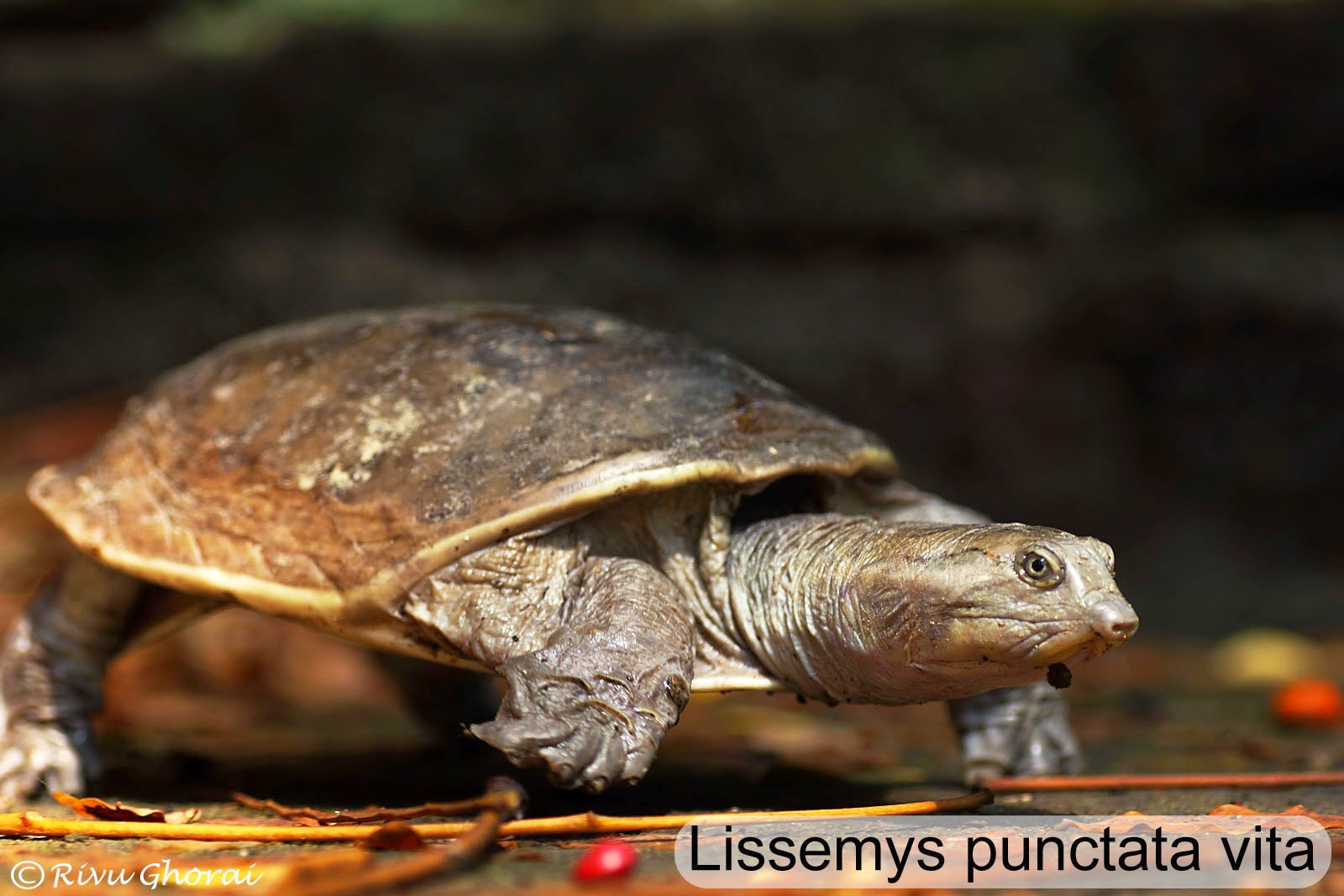
Of the 26 species that are found in India, 22 are under commercial pressure of various magnitudes. But the species which faces the maximum pressure is Indian Flapshell Turtle or Indian Mud Turtle (Lissemys punctata). It has three sub-species in India. L. p. punctata is found in Kerala, Tamilnadu etc states. L. p. andersoni is found in Pakistan, North India, Southern Nepal, upto Bangladesh and Mayanmar through Brahmaputra valley in the east. L. p. vita is distributed from southern Gujrat through Karnataka, Andhrapradesh, upto Orrissa in the east. So it seems the turtle is distributed in whole India except the state, Kashmir. Also as it mostly stays in areas near human habitation, it is one of the most popular turtle too.

The main reason of its wide distribution is its choice of habitat. It is a generalist when it comes to the choice of habitats. It is found in various type of wetlands like river, canal, pond, lake, paddy field even in drains, manholes of many cities. Though it is a fresh water species, it can bear with moderate level of saltwater. That’s why it is also found in estuaries of Sundarban, Bhitarkanika, Kuringa etc places. But it prefers swallow waters. It is also a generalist in terms of prey preference. Its food list includes frog, tadpole, fish, earthworm, crustaceans, molascs, waterplants, and many other things. It also scavenge on dead bodies and keep water bodies clean. Like many other reptiles, turtle also hibernates. In North India hibernation occurs between November and February. Another very interesting behavior seen in these turtles is aestivation. In summer months, if the water body dries up, they leave it and find another one. But if drought has dried up all the water bodies then these turtles aestivate inside mud. Many times this behavior proves to be a life saving one. Time of mating differs in these turtles locality wise. But everywhere it is related with Monsoon. Generally in North India, mating occurs in the month of April-June and egg laying occurs in the month of September-November.  An average clutch contains 9-15eggs. Incubation period is 270-350 days.


Commercial harvesting and selling of turtles has not gained much popularity until the seventies. Turtles were exploited but in a local scale. Mainly the fisherman folks were involved in this. But after seventies the situation changed rapidly. A racket came into play for commercial harvesting and selling of turtles in various places. All species of turtles were exploited but mainly Asian Giant Softshell Turtle, River Terrapin, Gangetic Softshell Turtle, Indian Mud Turtle were exploited most. The first two species are almost extinct in their natural habitat because of this commercial pressure. Now the other two species are mostly found in market. In this trade, Howrah has become one of the main trade center from the beginning. Turtles were transported here from Andhra Pradesh, Orissa, Jharkhand, Bihar, Uttar Pradesh and Assam. Previously train was the main transport option used by this trade. It was easier to hide the turtles in fish parcels. This trade has peaked in the eighties. In 1991, forest dept has seized 4448 turtles from Kolkata of which 4053 were Indian Mud Turtle. 2926 nos of turtle were seized from Kolkata in 1992 of which 2732 were Indian Mud Turtle. In an average approximately 50-60 thousand turtles were sold in Howrah market alone every year. Later by the activeness of Forest Dept turtle meat trade has gone underground. The main market has now shifted from Howrah to sub-urban areas and Bangladesh border. The transportation system has also shifted towards Bus and Truck. This has somewhat reduced the size of the trade, but it did not stop the trade all together. Till now trucks are seized in various parts of India carrying turtles.


Indian Mud Turtle enjoys the ‘Schedule I’ protection of Indian Wildlife (Protection) Act, 1972, which is the highest protection in our country.  Though, only legal protection has never saved any species from extinction. One bright side of its wide distribution is that many National Parks and Sanctuaries are within its range which will protect a healthy population of this species. One very interesting fact is that in spite of this severe pressure from commercial exploitation, this turtle has hold its ground in almost all its range. Still it is a ‘common’ species in most of its range. Now only time and our actions will tell how long can it retain its ‘common’ status, or become extinct in its natural habitat just like River Terrapin.

Thursday, January 16, 2014

New Year Gift ( Yellow Speckled Wolf Snake)

This day I got a call from a friend asking me if I would collect a snake they have captured or would they kill it. And I certainly told him to keep the snake for me. Then I asked him about the description of the snake and came to know that it is a green snake with spots on it. I was not sure which snake it was from the description but as it is not similar to any venomous snakes found here locally, I told him, “it is probably a non-venomous snake but still don’t touch it.”

This conversation happened in the morning and I was told to pick up the snake in the evening. The whole day I was thinking about the snake but could not decide what it could be and in the evening when I received the snake, reality exceeded all my expectations! It was a small snake, approximately 12”-14” long with brownish green back and white belly. Moreover it had two yellow spots on each scale. And I shouted in joy, “it’s a yellow-speckled wolf snake!!!!” whenever I saw its photo in books and various online groups, I wished to see one in real life but its distribution is so limited that I never thought I would see one ever, that too in my hometown. It was 2nd January and all I could think was that this was the best new year gift ever.

Yellow Speckled Wolf Snake ( Lycodon jara ) is a non-venomous snake found from West Bengal, Arunachal Pradesh and Ganjam district of Orissa in India and also from Nepal and Bangladesh. The maximum length recorded is 22”. It’s a smooth scaled, slender bodied snake. The head is slightly broader than the neck like all other wolf snakes. The upper side varies from glossy brown to purplish black. Belly side is white in color. Almost all the scales on its back have two yellow spots on them and thus the name. Sometime the spots are white in color. Very little is known about this snake. Only that it is a nocturnal snake and it eats geckos.
From my personal observation I found that this snake prefers corners and crevices than open place. Though it is a nocturnal snake, given a choice to stay between a dark open place and a bright corner, it feels more secure in the corner. It also hides its head slightly under its body coil like a few other wolf snakes. “And unlike the Common Wolf Snake, not tempermental and usually does not bite when handled.” Though the previous line was written for a few other wolf snakes like Barred Wolf Snake in the book ‘Snakes of India, The Field Guide’, I found it perfectly suitable for this one too.

When I released it in my own front yard, it was very quick to vanish from my eye and I am sure not to see it again ever though it is just in front of my house. Snakes have evolved to stay hidden so good that we often don’t realize how many snakes are there around us. That is infact in the benefit of both of us. Otherwise we would have killed all the snakes if we had the chance, or atleast that is the mentality of many of us. But it is good to know that people are changing. Thank you Utpal Das for this wonderful new year gift.

Saturday, November 16, 2013

Snake Dancing dilema

For the last few years, I was getting information about an age old tradition of snake dancing on a particular date of year but could not locate the place or date in specific. This year the situation was different. Few of my friends have already got the information and asked me if I am interested to go with them or not. I had no reason to reject them, so I hopped on their bike and off we go.


It was a very interior village and I am not disclosing the name because I don’t want to promote this practice. Anyway when we reached there, first we located the people who actually do the performance. By talking with them we came to know about many things. This snake dancing on the occasion of Lakhsmi Puja (a celebration of the goddess of wealth) is almost 150yrs old. All through the rainy season they catch the snakes in and around their village. And they only catch Monocellate Cobra and Spectacled Cobra because of their spectacular hood display. Then on this occasion, they perform the snake dancing for 3 consecutive days and release the snakes in the nearby river. (well, I was skeptical about how many snake will survive after the release.) Just before the ceremony, the organizers have emptied the venom glands of the snakes by making them bite repeatedly into papaya stalk. This way the dancers will not have to worry about the bites they may receive during the show.

At the scheduled time they transferred all the snakes to a small stage that was set in the fair ground. Each snake was in its own earthen pot. There were total 30-40 snakes of various size and age group but all are mostly adult only a few sub-adults. Then they started the show. There were 3-4 performers on the stage and a few other men to assist them. Performers were bringing out snakes one by one, played with them a little bit, then put it into its pot. It was a modest show. The music was deafening. A big crowd had gathered around the stage and they were very enthusiastic. Dancers were playing with 1-2 snakes at a time. Even I noticed to get bitten a few times but they didn’t care. This went on for approximately half an hour and came to an end.

One thing struck in my mind, most of the snakes were injured. They have injury on their head and several places on their body. If this is the type of performance that I saw was going on, then they don’t have any chance of having that extent of injuries. When I expressed my concern to my friends, they showed me the pictures from the first day of the event. This took me by surprise.

People are holding 5-8 snakes together over their head. Snakes are biting each other ferociously; they are biting the performers also. Blood was seen everywhere. The performers were even seen rolling on the stage over the snakes, which is severely dangerous for the snakes. I was wondering how this could go on un-noticed by the forest dept. Then from a member of the organizers I came to know that forest dept had stopped the program for 3 years in the past. But like all other activity in our country, they had made some arrangement with the local forest dept. So I guess this will go on for another few years in the future.